UPF 50 Beach Shade Explained: Australian Sun Guide
Demystify sun ratings with our guide to UPF 50 beach shade fabric science, UV index changes, and how to stay safe on Australian sands this summer.
Published 2026-10-24T20:00:26.333+00:00
Heading to the Australian coast on a blistering summer morning requires more than a towel and a water bottle. With our extreme solar climate and clear southern skies, finding a high-performance upf 50 beach shade is essential for safeguarding your family against intense ultraviolet radiation. But what does this rating actually signify when sand reflection, shifting solar angles, and wind gusts enter the equation? In this comprehensive beach guide, we explore the fabric science behind certified sun shelters, break down the movement of the UV index across coastal days, and reveal how to get genuine all-day protection on the sand.
Understanding UPF ratings: The fabric science of sun protection
When preparing for long coastal days under the harsh Australian sun, choosing reliable shelter comes down to verifiable fabric science. The Ultraviolet Protection Factor, or UPF, is the global benchmark measuring how effectively textiles shield your skin from solar ultraviolet radiation. While SPF measures how long topical sunscreen protects against burning UVB rays, UPF evaluates the penetration of both UVA and UVB wavelengths through woven textiles.
A certified UPF 50 beach shade fabric allows less than one-fiftieth—or a mere two percent—of ambient UV radiation to penetrate its weave. Achieving this high standard demands specialised manufacturing techniques, including high-density thread counts, tight yarn geometries, and dedicated UV-absorbing coatings applied during the finishing process. Without this precision engineering, ordinary lightweight cotton or low-grade polyester fabrics leave microscopic gaps where ultraviolet energy passes straight through.
For beachgoers stretching out across coastal dunes from Noosa to Cottesloe, textile density is paramount. Thin, untreated canopies might cut visible glare, but they do not guarantee safety from invisible cellular damage. Reliable shelters rely on robust synthetic fibres like premium Oxford polyester, which naturally resist photolytic breakdown while maintaining structural integrity across repeated exposure cycles in punishing coastal salt and sun.
UVA versus UVB: Why full-spectrum filtration matters
Solar radiation striking our coastlines consists of both short-wave UVB and long-wave UVA rays. UVB causes immediate redness, sunburn, and superficial skin cell mutations. In contrast, UVA penetrates deep into the dermis, accelerating premature skin ageing and promoting long-term skin health risks. A certified UPF rating ensures balanced, full-spectrum defence against both types.
Low-quality beach umbrellas often filter only visible sunlight, creating an optical illusion of cooling comfort while letting dangerous UVA wavelengths stream right through. To ensure your canopy delivers genuine shielding, always verify independent testing standards conducted under Australian test methods like AS 4399, which scrutinise both wet and dry filtration capabilities across the entire solar spectrum.
Why a certified UPF 50 beach shade is essential in Australia
Australia experiences some of the highest ambient solar radiation levels on the planet, driven by our clear skies, seasonal proximity to the sun during perihelion, and an ozone layer naturally thinner than that over the Northern Hemisphere. Consequently, spending an afternoon beside the surf without a verified UPF 50 beach shade significantly increases the risk of severe cumulative sun damage.
Ambient ultraviolet intensity spikes dramatically along our coastlines between late spring and early autumn. In southern capitals like Sydney, Melbourne, and Adelaide, as well as northern hubs like Brisbane and Perth, summer readings routinely surpass extreme danger thresholds. In these conditions, unshielded skin can begin burning in fewer than ten minutes, making durable overhead protection non-negotiable for families and beach lovers alike.
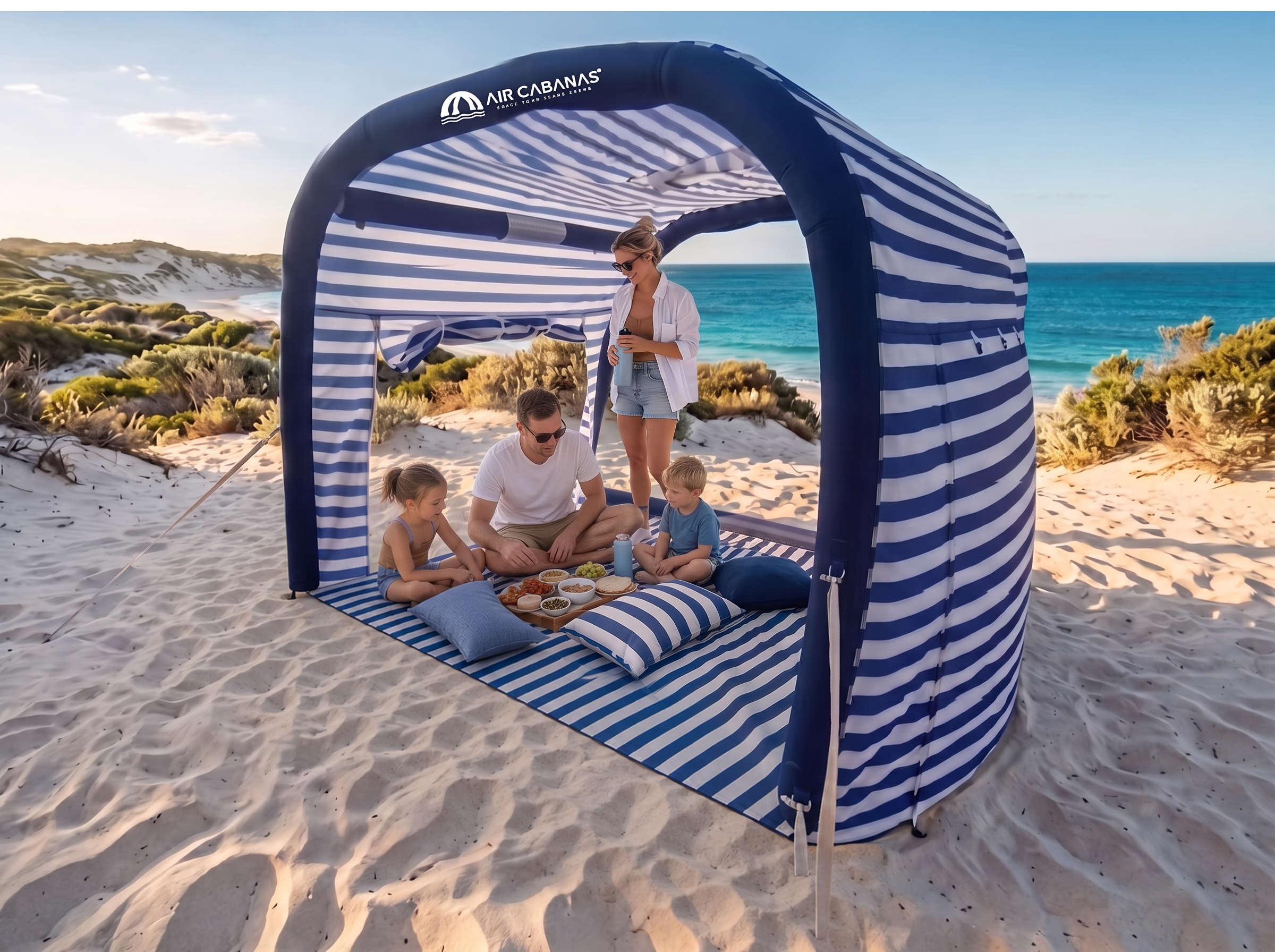
Deploying a high-calibre canopy establishes an indispensable thermal and ultraviolet sanctuary on open sand. Contemporary designs like an inflatable air cabana eliminate the rigid metal scaffolding of traditional beach gear while ensuring the canopy material remains properly taut. A taut, uncompromised textile surface prevents stretching that could otherwise widen microscopic yarn gaps and compromise your UV defence.
UV index and shade coverage across the day: Navigating solar angles
Tracking the local UV index and shade coverage across the day is crucial for keeping your group properly protected. Solar intensity does not remain constant; it tracks an arch that peaks when the sun sits directly overhead at solar noon. When the UV Index surpasses 3, sun protection is officially required, but on Australian summer shores, the rating routinely climbs past 11 or 12, reaching extreme risk territory.
As the solar angle shifts from mid-morning to late afternoon, the shadow cast by your shelter travels continuously across the sand. Early in the morning or late in the afternoon, low-angle rays strike horizontally beneath overhead canopies. Maximising your protective footprint requires proactive positioning, tilting or adjusting sidewalls, and shifting your towel inwards to stay centered beneath the densest footprint of fabric.
Many beachgoers mistakenly assume that once they are situated under canopy fabric, their sun routine is finished. However, midday conditions require ongoing vigilance. Maintaining generous perimeter margins inside your shelter ensures you remain directly beneath the core UV-blocking canopy zone, even as solar rays shift angle throughout a four-hour beach session.
Managing the midday surge on Australian coastlines
Between 10:00 am and 3:00 pm, more than sixty percent of daily ultraviolet radiation reaches the earth. During these peak hours, even minor gaps in shade coverage can lead to unexpected burns. Ensuring your setup provides ample square footage allows everyone in the family to sit well clear of the perimeter boundaries where direct sunlight creeps in.
Opting for an expansive canopy ensures adequate overhead clearance and broad lateral shelter. Modern options such as the AirCabana family model provide generous spans that accommodate parents, children, and eskis comfortably, shielding your entire group from overhead solar peaks during the most intense hours of coastal heat.
Ground reflection: The hidden UV threat on open sand
One of the most overlooked realities of coastal shade is ground reflection. Beach sand is a highly reflective surface, bouncing between 15 and 25 percent of incident UV radiation back upward beneath shade canopies. Combined with scattered surface glare from rolling whitewash and shorebreaks, this indirect radiation means ambient rays can reach your skin from below and beside your canopy.
This reflective phenomenon explains why beachgoers sometimes end up with facial burns or reddened shoulders despite sitting faithfully beneath a high-grade UPF 50 beach shade all afternoon. Overhead textiles eliminate direct vertical rays, but they cannot absorb ambient radiation rebounding off adjacent white sand banks. Addressing this challenge requires an integrated approach to outdoor sun safety.
To counteract diffuse and reflected scatter, broad-spectrum sunscreen, wide-brimmed hats, and UV-rated sunglasses remain vital companions to your physical canopy. Positioning your shelter on damp, compact sand rather than pale, dry quartz dunes can also subtly reduce surface albedo, limiting the volume of indirect scatter ricocheting into your seating area.
Fabric wear, moisture, and tension: Maintaining maximum UPF performance
The technical rating assigned to shade fabric is measured under pristine laboratory conditions, but real-world beach environments present distinct challenges. Sand abrasion, saltwater spray, chlorine, fabric tension, and continuous UV breakdown will gradually degrade textile performance if your gear is not properly cared for. Understanding how fabric science reacts to coastal elements preserves long-term protection.
When canopy textiles become saturated with seawater, their protective rating can drop considerably. Water filling the tiny spaces between synthetic yarns can alter optical refraction, allowing extra UV radiation to pass through. Choosing high-density woven fabrics with hydrophobic treatments helps water bead off rapidly, keeping the weave dry and structurally tight during coastal downpours or heavy sea mist.
Physical tension also plays a vital role. In traditional pole-frame cabanas, thin cotton-blend fabrics are often pulled unevenly across sharp metal joints, creating stretched zones where the weave loosens and lets UV light penetrate. By contrast, an AirCabana utilises uniform inflatable air beams that distribute canopy tension smoothly across every seam, eliminating fabric stress points and preserving the integrity of the protective weave.
Best-practice care for your beach canopy fabric
To extend the lifespan of your canopy, rinse it thoroughly with fresh tap water after every trip to remove corrosive salt crystals and fine abrasive grit. Allow the fabric to air-dry completely in a shaded, well-ventilated area before packing it away in its carry bag, which prevents mildew and coating degradation.
Never use harsh industrial detergents or machine wash high-performance shelter fabrics, as abrasive wash cycles can strip protective coatings. A gentle sponge down with lukewarm fresh water is all that is required to keep your UPF 50 beach shade performing reliably summer after summer.
Selecting your setup: Inflatable air tubes versus pole-frame cabanas
When shopping for a coastal shelter, modern beachgoers face a clear choice between older pole-frame cabanas and modern inflatable air-tube systems. While traditional cool cabana setups rely on telescoping aluminium poles and central uprights, inflatable air cabana engineering replaces metal scaffolding with heavy-duty air beams, completely transforming setup simplicity and seaside safety.
Rigid metal poles carry real hazards during unexpected coastal gusts. Stiff aluminium components can bend, snap, or tear through delicate canvas sleeves, whereas inflatable beams flex smoothly under wind pressure and absorb kinetic energy without bending out of shape. For families with active kids, eliminating heavy metal poles also removes pinch hazards and hard knock risks around the campsite.
Modern inflatable designs engineered by AirCabana pair rapid dual-action pump inflation with high-tensile UPF 50+ canopy materials, delivering an exceptional blend of ease, stability, and high-level sun protection. Whichever design you select, stability always depends on diligent anchoring: fill every sand pocket completely, drive sand pegs at 45-degree angles, maintain active supervision, and always pack down your shelter if conditions turn unsafe.
Frequently asked questions
Here are clear, practical answers to common questions about UV ratings, shade performance, and coastal sun protection on Australian beaches.
What does UPF 50 actually mean for beach shade?
A UPF 50 rating means the canopy fabric allows only 1/50th (or approximately 2 percent) of the sun's ultraviolet radiation to pass through. It blocks roughly 98 percent of both UVA and UVB rays, providing the highest standard of fabric-based sun protection available under Australian testing guidelines.
Can you still get sunburnt under beach shade in Australia?
Yes, you can still burn beneath beach shade due to reflected ultraviolet radiation. Coastal sand reflects up to 25 percent of UV rays back upward under canopies. To remain fully protected, pair your canopy with broad-spectrum sunscreen, protective clothing, and sunglasses.
Is UPF 50 better than SPF 50 for beach canopies?
UPF and SPF measure different things. SPF applies exclusively to topical lotions and measures UVB protection on skin. UPF applies specifically to woven fabrics and measures filtration against both UVA and UVB rays. For beach canopies and outdoor textiles, UPF is the correct rating to check.
Does wet shade fabric lose its sun protection?
Yes, many wet fabrics lose sun protection because water droplets between fibres alter light refraction, allowing more UV rays to penetrate. Choosing high-grade synthetic textiles with water-repellent coatings ensures the fabric repels moisture and preserves its certified UPF 50 rating even in damp sea spray.
How much shade do I need for a family of four?
A family of four needs at least 4 to 5 square metres of canopy coverage to remain protected from shifting solar angles throughout the day. Generous shelters like the AirCabana family provide ample footprint, ensuring everyone stays completely within the protective overhead zone as the sun moves across the sky.