Metal-Free Beach Shade: Why We Removed the Poles
Discover why a metal free beach shade built with air-tube engineering offers safer, corrosion-free beach days for Australian families across our coastline.
Published 2026-10-25T20:00:41.655+00:00
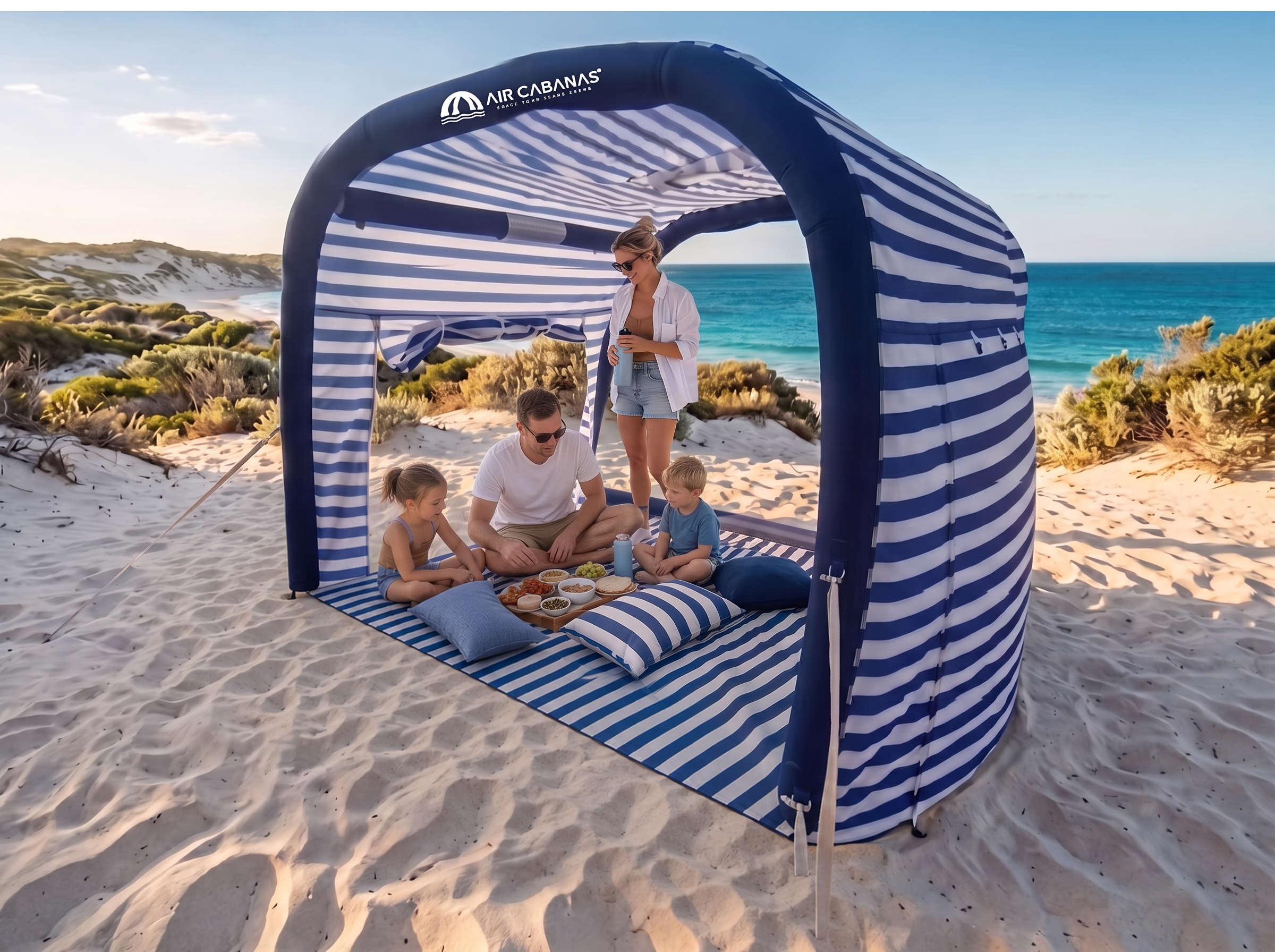
Across Australia, a perfect morning on the sand can change in an instant when the afternoon sea breeze rolls in. For decades, coastal families have put up with the rattles, pinched fingers, and sudden stress of traditional pole-frame cabanas, watching warily as rigid metal poles shudder and strain under every coastal gust. That structural vulnerability led us to rethink coastal shelter from the ground up. By embracing high-strength air-tube engineering, we realized that creating a completely metal free beach shade was not just an alternative design—it was the essential key to safer, more relaxed beach days for Australian families.
The Hazard of Aluminium on Crowded Coastlines
Australian beaches are dynamic environments where afternoon sea breezes, tumbling swell, and crowded stretches of sand intersect. For decades, conventional shade structures have relied on telescopic aluminium uprights, steel crossbars, and sharp central pins. While these mechanisms were once considered the standard for coastal comfort, anyone who has spent a summer afternoon on an exposed shoreline knows the uneasy feeling of watching rigid metal poles shake violently in an escalating onshore gust. Rigid materials transmit every ounce of aerodynamic force directly into joint fittings, creating mechanical leverage that can wrench pegs clean out of loose sand.
When structural joints fail under pressure, the consequences extend well beyond a ruined afternoon. Fractured aluminium poles can snap, splinter, or turn an entire shade shelter into an airborne projectile tumbling across sunbathers and playing toddlers. Traditional metal frames present genuine pinch hazards during both setup and pack-down, with sand-clogged slider collars jamming and snapping down on fingers. Parents frequently find themselves serving as human guy-wires, clinging anxiously to shuddering metal uprights rather than enjoying their swim, simply because a rigid frame lacks the compliance needed to absorb changing coastal currents safely.
Salt air, moisture, and fine quartz sand also wage an unrelenting war against metal hinges and telescopic locks. Even anodised metals begin to seize after a handful of saltwater immersions, leading to stubborn mechanisms that require excessive force to disengage. This mechanical decay compromises structural integrity long before visible rust appears, increasing the likelihood of an unexpected collapse on a breezy day. Moving away from these traditional frameworks is not merely an aesthetic choice; it represents a fundamental rethinking of coastal safety, replacing rigid vulnerability with resilient, forgiving materials designed specifically for the unique demands of our coastline.
Why Traditional Pole Frames Fail Under Pressure
Standard pole-frame cabanas rely on unyielding geometry. When a gust of wind strikes a taut fabric canopy supported by rigid aluminium, the force has nowhere to disperse except downward into the ground anchors or outward into the brittle corner brackets. Once that threshold is breached, the metal bends irreversibly, or the central spire pulls loose from the sand, transforming what should have been a relaxing shelter into an unpredictable hazard tumbling down the beach.
The maintenance lifecycle of metallic shelters is equally fraught. Salt crystals lodge deep within the sliding sleeves, grinding away protective coatings and causing sudden jams. When beachgoers attempt to force stuck release buttons with sandy thumbs, clips shear off or snap shut unpredictably. By eliminating rigid metal entirely, coastal shade evolves past these friction points, exchanging brittle leverage for responsive elasticity.
Air-Tube Engineering: Structural Support Without the Steel
The foundation of our approach lies in advanced air-tube engineering, a principle borrowed from high-performance marine rescue craft and technical alpine basecamps. Rather than relying on unforgiving hollow metal, this design utilizes high-tensile, multi-layered thermoplastic polyurethane (TPU) air bladders encased within ultra-durable ripstop sleeves. When pressurized with a standard hand pump, these pneumatic arches achieve remarkable rigidity while retaining an intrinsic flexural elasticity. The air beams hold their architectural form cleanly against the skyline, yet they retain the capacity to bend gracefully when struck by sudden turbulence, shedding aerodynamic loads that would buckle steel.
This pneumatic architecture shifts the entire physics of seaside shade. In traditional shelters, every gust creates a battle between wind force and metal shear strength. With precision-engineered air channels, the shelter absorbs the kinetic energy of the wind and naturally bounces back into shape the moment the gust passes. There are no brittle rivets to pop, no cross-struts to bend out of alignment, and zero structural fatigue from cyclic wind stress. The entire framework works in harmony with the atmosphere rather than attempting to fight it through brute, rigid resistance.
Deploying an inflatable framework also simplifies every aspect of transport and assembly on the sand. Traditional steel components are cumbersome, rattle noisily in transit, and require complicated spider-joint unfolding routines that quickly become overwhelming in breezy conditions. An inflatable rib network rolls into a compact, lightweight bundle that unpacks flat on the sand. Once the four corner ballast points are anchored, rapid inflation raises the entire profile in mere moments, eliminating the struggle of wrestling with unruly metal arms while managing towels, boards, and excited children.
Understanding Inflatable Beam Mechanics
The secret behind high-pressure air-tubes is uniform radial tension. Because internal air pressure exerts an equal outward force across every square millimetre of the bladder wall, the structural beam boasts an exceptional strength-to-weight ratio. It supports the upper canopy tautly to prevent flapping, yet it contains zero hard contact points. If an errant football or stumbling child collides with an air beam, the structure yields gently without injury or denting.
Durability is reinforced through layered protection. The inner airtight bladder is shielded by a dense, puncture-resistant outer casing engineered to withstand sharp shell fragments, coarse coastal sand, and harsh ultraviolet exposure. Should an extreme squall strike unexpectedly, the pneumatic arches simply flex downward temporarily to dump the wind spill before recovering their upright stance, preventing the catastrophic structural failures typical of pole assemblies.
Why a Metal Free Beach Shade Means Safer Beach Days
Opting for a metal free beach shade transforms your entire coastal experience by removing the underlying anxieties associated with hard-framed shelters. Coastal outings should revolve around uninterrupted family leisure, listening to the surf, and cooling off in the water—not constantly scanning the horizon to see if your shelter is about to launch into the neighbouring family's setup. When your shelter is entirely devoid of steel, aluminium spires, and pointed stakes, the beach environment becomes fundamentally safer for everyone sharing the foreshore.
Consider the everyday realities of a busy Saturday on an Australian beach: children sprinting between the waves and the towels, friends diving for catches, and curious toddlers wandering across camp boundaries. In a traditional setup, tripping over a low metal outrigger or brushing against a sun-baked aluminium leg can result in bruising, cuts, or painful contact burns. A pneumatic cabana features soft, compliant perimeters at every level. If a child runs full-tilt into an air beam, they bounce harmlessly off a cushioned air cushion, turning a potential trip to the first-aid station into laughter.
Furthermore, peace of mind during sudden weather changes cannot be overstated. While no temporary shelter should ever be left standing in dangerous gale conditions, afternoon coastal breezes can kick up without warning. If an unexpected gust causes an inflatable shade to shift, there are no jagged metal edges or heavy crossbars to inflict trauma on anyone downwind. The entire unit remains a lightweight, yielding mass of fabric and air. When you choose a metal free beach shade, you are making an active choice to protect your family and your wider beach community from avoidable hazards.
Family Protection and Soft-Touch Coastal Leisure
The sensory benefits of removing metal are just as tangible as the physical safety advantages. Aluminium poles become scorching hot under the midday Australian sun, often reaching temperatures capable of stinging delicate skin upon contact. In contrast, heavy-duty woven textiles over air beams remain comfortable to the touch throughout the hottest parts of the day, allowing children to rest against the shelter supports without discomfort.
Additionally, the absence of rigid poles eliminates the clatter and groaning noises common to metal frames straining against the breeze. Families enjoy a serene, flap-free sanctuary where conversation and the gentle sound of the ocean take centre stage. It is an elevated interpretation of what a cool cabana ought to deliver: reliable sun protection wrapped in an intuitively secure, user-friendly footprint.
Corrosion Resistance: Engineered for Salt, Sand, and Sun
The Australian maritime environment is notoriously harsh on recreational equipment. Between corrosive salt spray, high humidity, fine abrasive silica, and extreme UV radiation, traditional beach shelters face constant degradation from their very first day outdoors. Metal hardware—even so-called marine-grade stainless steel or powder-coated aluminium—eventually succumbs to galvanic corrosion, pitting, and oxidation. Sand invariably works its way into sliding joints, locking pins, and spring-loaded ball detents, turning what should be a smooth pack-down into a frustrating, knuckle-grazing battle at the end of the day.
In contrast, a metal free beach shade relies exclusively on synthetic polymers, advanced textiles, and high-frequency welded seams that are fundamentally impervious to saltwater corrosion. Sand cannot seize a moving part that does not exist. Salt spray can coat the structure all day without triggering oxidation, and an afternoon rinse with fresh water at the outdoor tap is all that is required to restore the shelter to pristine condition. By eliminating metal, you remove the primary driver of premature gear failure, ensuring your investment delivers seasons of dependable service rather than ending up in landfill after a single summer.
UV stability is another critical factor in coastal longevity. Low-grade metallic shelters often use thin plastic junction knuckles that degrade and crack under intense ultraviolet exposure, causing the metal poles to pull away from the canopy. High-performance air cabana designs integrate marine-grade UV inhibitors directly into both the outer fabric canopy and the protective beam sleeves. This cohesive material strategy ensures that every component degrades at an extraordinarily slow, uniform rate, completely immune to the structural cracking that plagues multi-material frames.
Zero-Maintenance Durability for Coastal Living
Packing up after a long day in the surf should never involve wrestling with stuck aluminium push-pins or trying to scrape crusty salt residue out of telescopic tubes. Because pneumatic shelters eliminate friction-based mechanical slides, the pack-down routine is as straightforward on day one hundred as it is on day one. Simply release the rapid-deflation valve, watch the air dissipate in seconds, and fold the supple fabric neatly into its shoulder bag.
This effortless resilience makes inflatable shade ideal for impromptu coastal lifestyles. Whether tossed in the back of the wagon damp from an evening dip or stored in the garage through winter, there are no internal springs to rust shut, no joints to seize, and no bent poles preventing the canopy from folding down smoothly. It is true grab-and-go coastal convenience built for the Australian climate.
Effortless Solo Setup and Rapid Pack-Down
We have all witnessed the stressful beach ritual: one person desperately holding a wobbling pole against the wind while another struggles to locate the right locking pin, all while the canopy acts like a runaway sail. Traditional pole-frame cabanas demand coordinated effort, multiple pairs of hands, and substantial patience to erect securely. When you are managing young children, beach bags, and surfboards, the setup process can quickly become the most exhausting part of the entire outing. Shade should alleviate stress, not create it before you have even stepped onto the wet sand.
Air-tube shelters turn this dynamic on its head by enabling effortless, single-person operation under real-world coastal conditions. To set up an AirCabana, you simply lay the four-corner base flat on the sand, fill the integrated sand pockets to establish broad ballast anchors, and attach the high-output manual pump to the central valve. With smooth, low-resistance strokes, the internal ribs inflate in under two minutes, smoothly lifting the UPF 50+ canopy skyward without any manual lifting of heavy crossbars or guessing which pole connects where.
Pack-down is even faster, eliminating the dreaded end-of-day scramble when the tide is creeping up or the kids are overtired. Unscrewing the quick-release valve dumps the internal air volume instantly. The shelter settles gently to the sand like a deflating parachute, entirely free of falling metal uprights or snapping crossbeams. Emptying the corner ballast sand pockets takes seconds, and the entire unit rolls smoothly into its compact carry bag—ready for the stroll back across the dunes without cumbersome poles digging into your shoulder.
Step-by-Step Solo Deployment Protocol
1. Unroll the shelter canopy flat against the sand with the entrance facing away from direct onshore wind. 2. Generously fill all corner ballast pockets with damp sand using your hands or a scoop to build immediate anchoring weight. 3. Connect the pump nozzle securely to the one-way inflation valve. 4. Pump until the air beams are firm and upright, which typically requires under ninety seconds of steady pumping. 5. Walk around the perimeter to ensure each ballast corner sits flush, and add guy lines if afternoon conditions freshen.
Because the structure gains its form through air pressure rather than mechanical tension, there are no awkward moments where half-erected poles can twist in a sudden gust. If an unexpected wind shift catches the canopy midway through inflation, the soft-sided beams simply bend without buckling, allowing you to finish pumping without fighting rigid leverage.
Correct Anchoring and Coastal Care for Inflatable Shade
While transitioning to an air-tube cabana eliminates rigid metal hazards, all beach shelters remain subject to the basic laws of physics and atmospheric aerodynamics. Genuine coastal safety relies on diligent anchoring, ongoing situational awareness, and responsible stewardship of your gear. No beach canopy is wind-proof, and responsible beachgoers understand that proper ground ballast is what keeps your shade grounded, secure, and performing as engineered throughout the day.
The golden rule of pneumatic shade stability is ballast mass. The generous corner pockets integrated into modern inflatable cabanas are designed to hold substantial volumes of sand. Always dig down slightly to reach damp, compacted sand rather than relying on dry, powdery surface dust; wet sand is significantly denser and creates a far more stable anchor foundation. Ensure that all four pockets are filled to capacity before walking away to swim, and never rely solely on corner stakes when pitching on soft coastal dunes or powdery sand flats.
Equally vital is knowing when to call it a day. Coastal weather on Australian beaches can deteriorate rapidly, with southerly busters and squalls capable of producing turbulent gusts that exceed safe recreational limits. Always keep an eye on changing conditions, observe how nearby flags and trees are behaving, and supervise your shelter attentively. If conditions escalate to the point where sand is blowing horizontal, other beachgoers are packing down, or your shelter is flexing continuously, act proactively: unscrew the quick-release valve, pack the cabana into its bag, and head safely off the sand.
Essential Maintenance and Safe Usage Practices
To maximise the lifespan of your inflatable cabana, make fresh-water rinsing a routine part of your post-beach care. While the materials will never corrode, clearing away fine grit from the inflation valves and zipper seams preserves their airtight seals for years. Allow the canopy to air dry thoroughly in the shade before packing it into long-term storage to prevent mildew from forming on the waterproof fabric coatings.
Never leave an erected shelter completely unattended for extended periods, and always ensure active adult supervision when children are playing around or inside the cabana footprint. By combining the natural safety advantages of a metal-free framework with conscientious anchoring and weather awareness, you ensure that every coastal adventure remains relaxed, comfortable, and completely stress-free.
Frequently asked questions
What makes a metal free beach shade safer than pole cabanas?
A metal free beach shade replaces rigid aluminium and steel poles with inflatable TPU air-tubes. Without brittle metal components, there are no sharp spires, pinch-point hinges, or heavy rods that can snap or tumble dangerously down a crowded beach during sudden wind gusts. Families enjoy soft, cushioned contact points that protect active children and eliminate painful burns from sun-baked metal frames.
How does an air cabana stay upright in coastal winds?
An air cabana maintains structural integrity through pressurized pneumatic beams paired with deep sand ballast pockets at each corner. When coastal gusts hit the canopy, the flexible air beams yield slightly to dump excess wind spill, then instantly bounce back to their upright profile. Dense sand placed in the corner pockets provides robust downward anchorage without requiring rigid spires driven into the ground.
How long does it take to pump up an inflatable beach shade?
Inflating an air-tube cabana typically takes between sixty and ninety seconds using the included high-capacity manual pump. Because the internal air beams inflate simultaneously through a centralized valve, solo beachgoers can fully raise the entire shelter in under two minutes without wrestling with tangled telescopic arms, joint brackets, or awkward corner pins on breezy shorelines.
Can salt and sand damage an inflatable beach cabana?
Unlike traditional pole shelters that seize up from salt corrosion and sand grit lodged in sliding joints, inflatable cabanas use corrosion-proof polymers and sealed TPU bladders. There are no metal surfaces to rust, pit, or oxidize. A quick rinse with fresh tap water after your beach trip easily washes away salt residue and keeps valves operating smoothly season after season.
What should I do if the beach wind suddenly gets too strong?
No shade shelter should remain pitched in severe squalls or gale conditions. If coastal winds increase noticeably and cause continuous structural deflection, open the rapid-deflation valve immediately. The shelter deflates safely flat on the sand in seconds without violent tumbling, allowing you to empty the sand pockets, roll up the fabric, and pack down without risking safety.