Inflatable vs Pole Beach Cabanas: Which Setup Actually Wins on the Sand?
Inflatable air-beam cabanas and pole-frame cabanas solve the same problem in different ways. Here is how they compare on setup, wind behaviour, repairs, durability and everyday practicality.
Published September 18, 2026
Air beams have quietly taken over parts of the camping world, and beach shade is following. But inflatable is not automatically better than poles. The right answer depends on how you set up, what you are willing to carry and how you handle repairs. Here is the honest comparison.
Setup: one action versus a sequence
A pole-frame shelter is a sequence: unpack, sort, join, thread, tension, anchor. Done in the right order it is fast. Done out of order, in wind, it is frustrating.
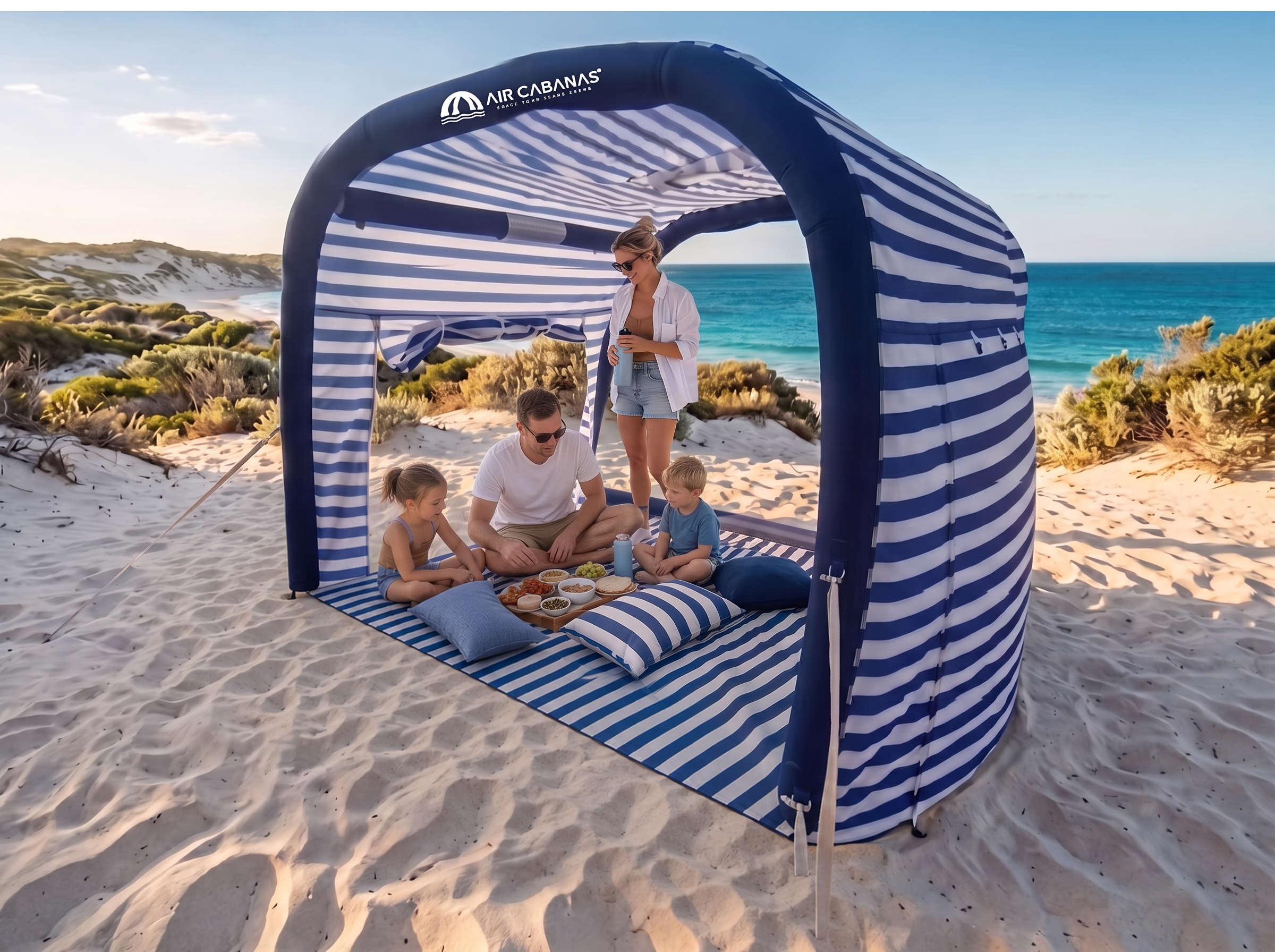
An inflatable shelter is closer to one action: unroll, inflate, anchor. AirCabana inflates in about sixty seconds with the included USB rechargeable pump, which is small enough to sit in your palm.
Solo setup
If one adult usually sets up while minding kids and gear, the single-action approach is the clearer winner. That is the most common real-world scenario we hear about.
Behaviour in coastal wind
Both designs depend far more on ballast than on frame type. A poorly anchored cabana of any construction will move. Fill every sand pocket or bag, keep the open side away from the strongest gusts and pack down early when conditions build.
Air beams do flex rather than stay rigid, which some people prefer in gusty conditions. This is a characteristic of the material, not a wind-proof claim — no beach shelter should be left up in unsafe wind.
Ventilation and comfort
The structure influences how open the shelter can be. Removing the lower front member gives AirCabana a fully open front span with nothing to step over, and the arch shape makes room for two roof ventilation flaps near the apex.
Roll-up side panels then let you choose between more airflow and more shade cover as the sun and breeze move through the day.
Damage and repairs
Poles bend and snap; sleeves tear. Air beams can puncture. Both are repairable, and both benefit from basic care: rinse salt and sand off, dry before storage, and avoid dragging the shelter across shells and rocks.
The practical difference is that a bent pole usually needs a replacement part, while a small puncture is typically a patch. Keep the cabana clean, store it dry and it will last far longer either way.
Care routine worth adopting
Empty the sand pockets, shake out the fabric, rinse with fresh water, dry fully in the shade, then bag it. Five minutes at home prevents most long-term wear.
Carrying and storage
Rigid poles fix the packed length of a pole-frame cabana. A fabric-and-air-beam shelter rolls, which usually makes storage easier in a boot or a cupboard shelf.
Remember to include ballast in the comparison. If sandbags are separate items, they are part of what you carry. AirCabana's pockets are stitched in, so the ballast travels inside the shelter.
Around children
Metal-free construction removes rigid poles and hard joints from the perimeter of the shaded area. Combined with an open front and no dangling anchor straps, the walk-in lane stays clear.
It is a design preference rather than a safety promise, but for families with toddlers it is often the deciding factor.
The verdict
Poles win if you already own a good frame cabana, enjoy the routine and do not mind separate hardware. Inflatable wins if you want fewer steps, fewer loose parts, a softer perimeter and easier solo setup.
AirCabana is built for that second group: a single continuous inflatable arch, integrated sand pockets, a fully open front and two roof vents, in two approved models and two sizes.