Beachfront Cabanas: Resort Luxury for Australian Beaches
Discover how resort beachfront cabanas achieve effortless luxury and how you can copy their breezy, sun-safe comfort with the ultimate portable beach setup.
Published 2026-10-31T20:01:32.596+00:00
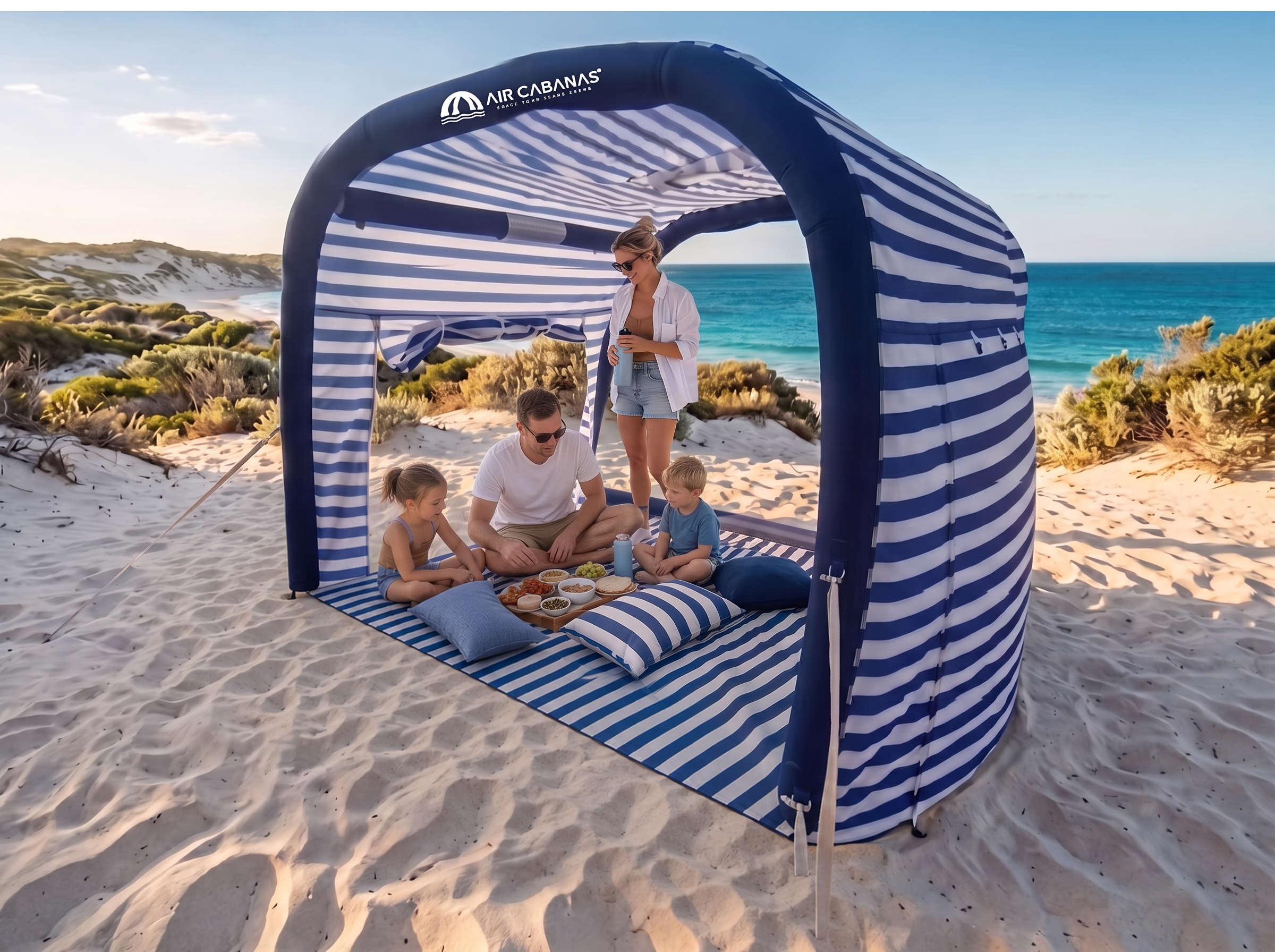
There is a reason we dream all winter of relaxing inside private beachfront cabanas at luxury coastal resorts. The generous ceiling height, the effortless thermal comfort, and the soothing ocean breeze create an experience that feels light years away from wrestling with a flapping beach umbrella on an overcrowded shore. But you do not need an overseas holiday or a private island booking to enjoy that five-star coastal feeling. With the right fabric technology, spatial styling, and modern air-tube shelter design, you can easily replicate world-class beachside luxury on any Australian beach this weekend.
The Architecture of Luxury: Why Resort Beachfront Cabanas Work
There is a distinct, unmistakable feeling that washes over you when stepping into high-end beachfront cabanas at a five-star coastal resort in Queensland or Byron Bay. It is not merely the chilled drinks or the manicured outlook; it is the deliberate environmental design. Resort operators have spent decades mastering microclimates, ensuring their beachside shelters offer genuine respite from punishing solar radiation while maintaining open airflow. Instead of trapping stagnant heat beneath low-slung, suffocating fabric, commercial setups embrace structural clearance, natural cross-ventilation, and fabrics calibrated to block heat transfer rather than simply casting a faint shadow.
The engineering secret behind commercial beachfront cabanas lies in how they manage tension, airflow, and elevation. By elevating the roof canopy well above eye level, resorts prevent the thermal dome effect—where heat radiates downward onto occupants. Furthermore, fixed pavilions use anchored corners that channel afternoon sea breezes smoothly through the living zone rather than catching wind like an open sail. For Australian beachgoers who endure some of the highest ultraviolet index readings on the planet, understanding these spatial mechanics is the first step toward transforming an uncomfortable coastal day into a restorative escape.
Fortunately, achieving this level of refined comfort does not require booking a thousand-dollar-a-night private pavilion on Hamilton Island. By understanding the core design principles that make resort beachfront cabanas so effortlessly welcoming, everyday coastal families can replicate the exact same ambience on unpatrolled public shorelines. It all comes down to translating resort cabana comfort into a portable setup that can be transported in a shoulder bag, erected on loose coastal sand, and enjoyed across an entire Australian summer without the structural headaches of older shade gear.
Elevation and Ceiling Height: Eliminating the Hotbox
When you sit beneath a makeshift tarp or an entry-level beach umbrella, the fabric often rests just inches above your head, capturing radiant heat and creating an unbearable micro-greenhouse. Luxury resorts avoid this entirely by maintaining minimum roof clearances of two metres or more. This critical elevation allows hot air to rise naturally and disperse out the sides before it ever touches your skin.
Replicating this vertical volume on open sand requires a shade shelter designed with generous upright proportions. When you step underneath a tall, open-sided canopy, you instantly experience ambient cooling because the volume of circulating air beneath the fabric is doubled. That breezy, open-air feeling is the true hallmark of luxury shorelines.
Translating Resort Cabana Comfort into a Portable Setup
For decades, the great Australian coastal dream was accompanied by severe logistical friction. Replicating the sturdy footprint of static beachfront cabanas meant hauling cumbersome steel frames, dealing with bent alloy rods, and wrestling with tangles of guy ropes that presented constant trip hazards for children running toward the surf. The moment an unexpected southerly buster clipped the shoreline, traditional pole structures would buckle or twist, turning a peaceful afternoon into a frantic salvage operation. Commercial resort pavilions work because they are rigid yet yielding; portable versions historically failed because rigid metal poles in dynamic sand are an engineering mismatch.
Translating resort cabana comfort into a portable setup requires breaking away from nineteenth-century frame architecture. Modern beachgoers are discovering that inflatable structural geometry solves the structural paradox of the beach. Instead of rigid metal that bends under tension, high-pressure air beams flex organically with gusting sea breezes and snap instantly back into alignment. The AirCabana platform embodies this technological shift, replacing brittle poles with marine-grade inflatable air tubes that can be brought to full structural rigidity in minutes using an included high-capacity pump.
When you eliminate metal framework from your coastal gear, the entire rhythm of your beach morning shifts. You no longer have to negotiate awkward central poles that split your lounge space in half or worry about pinched fingers during assembly. An inflatable cool cabana setup delivers the sweeping, clear-span architecture of luxury beachfront cabanas while packing down into a compact travel bag that tucks effortlessly into the boot alongside your eskies, boards, and beach towels. It represents an uncompromising translation of commercial indulgence into genuine weekend convenience.
The Fabric Science Behind True Thermal Protection
Walk into any premier coastal sanctuary along Australia’s sun-drenched coastline and you will notice that the fabric used in their shade structures looks and feels substantial. Commercial beachfront cabanas do not rely on flimsy, paper-thin nylon that allows ambient ultraviolet light to bleed straight through the weave. In Australia, where summer UV indices routinely soar into the extreme category past 11, the optical density of your canopy fabric directly dictates your physiological fatigue by mid-afternoon. A thin shade canopy might block the immediate glare, but invisible UVA and UVB rays continue to cook your skin and drain your energy.
To replicate resort-grade sanctuary on public sand, your portable shade must feature independently tested UPF 50+ materials with integrated thermal coatings. High-grade shade fabrics incorporate dense weave profiles treated with silver or titanium reflective undercoatings that actively bounce infrared radiation away from the shaded living zone. This fabric science keeps the ambient air beneath the canopy noticeably cooler than the surrounding exposed sand, mimicking the deeply shaded stone verandas of tropical island retreats.
Durability under salt and sun is another critical factor where domestic gear often falls short. Resort shelters are engineered with heavy-duty textiles that resist salt degradation, fabric rot, and colour blanching caused by unrelenting coastal ultraviolet exposure. Choosing an inflatable shade solution like the AirCabana Classic or the expansive AirCabana Family ensures you receive heavy-gauge, tear-resistant fabrics designed specifically to withstand harsh Australian coastal environments, ensuring that your investment delivers luxurious, protective shelter season after season.
Spatial Flow: Laying Out Your Beachfront Cabanas for Maximum Ease
A primary reason five-star beachfront cabanas feel so profoundly relaxing is the intuitive spatial separation between resting, dining, and storage. At a high-end resort, you never find sunscreen bottles buried in sandy towels, nor do you balance a condensation-heavy water flask precariously on an unstable fold-out chair. The interior environment is zoned to create seamless physical ease. Every amenity is accessible without disturbing the primary lounging footprint, preserving an atmosphere of uncluttered calm.
You can effortlessly recreate this spatial sophistication beneath your own portable shade shelter with a few thoughtful styling choices. Start by designating a dedicated perimeter drop-zone for sandy gear. Place heavy utility duffels, dry bags, and board shorts near the rear corners or just outside the windward entrance. Inside the shaded perimeter, lay down a large, woven sand-free ground mat that allows loose grains to sift straight through, creating an immaculate barefoot interior zone reminiscent of a polished timber cabana deck.
Elevating your seating completes the resort illusion. Rather than sitting directly on damp, baking sand, deploy low-profile, reclining beach loungers or padded ground chairs equipped with breathable mesh backings. Keep your drinks, fresh fruit, and personal essentials raised off the sand using compact, flat-folding camp side tables or integrated internal storage pockets. When every essential item has a dedicated station within your shaded footprint, your temporary plot on the coast transforms from a chaotic encampment into a curated outdoor sanctuary.
Anchoring Principles: Keeping Beachfront Cabanas Secure in Coastal Winds
The single biggest anxiety that shatters beachside tranquillity is structural instability. We have all witnessed the frantic scramble across crowded sand when an unsecured umbrella or poorly anchored shade frame goes cartwheeling into the surf on a gusty afternoon. At commercial establishments, beachfront cabanas remain serene because their anchoring foundations are engineered to distribute loads across wide surface areas. While mobile beachgoers cannot pour concrete footings into pristine national park dunes, they can apply the exact same physics of mass and ballast distribution.
The most dependable anchoring method on loose coastal sand is wide-base mass displacement. Traditional skinny metal stakes are largely useless in powdery shorelines because dry sand has minimal shear resistance; the moment tension is applied, vertical pegs simply pop out of the ground. By contrast, resort-style stability in a portable shelter relies on deep-fill sand pockets integrated directly into the structural corners. By packing these oversized fabric reservoirs with heavy, damp sand, you create counterweights that anchor the canopy firmly against upward aerodynamic lift.
Even with the robust architecture of modern inflatable air-tube systems, safety should always remain your paramount coastal priority. There is no such thing as an entirely wind-proof shade structure on an exposed ocean beach. Always orient your cabana so its lowest aerodynamic profile or reinforced rear wall faces directly into the prevailing sea breeze. Ensure all corner pockets and secondary guy lines are fully engaged and buried deeply. Most importantly, never leave your beach shelter unattended, maintain constant supervision of your setup, and always proactively pack your shelter down if sudden squalls, thunderstorms, or unsafe weather conditions roll in from the horizon.
The Modern Evolution: Ditching Rigid Poles for Inflatable Air Tubes
For generations, the portable shade market was dominated by heavy, complex pole-frame cabanas. While these designs served as an incremental improvement over unstable, single-pole umbrellas, they introduced a host of mechanical vulnerabilities that modern beachgoers are increasingly unwilling to tolerate. Slender steel or aluminium support rods are prone to snapping under sudden coastal turbulence, internal tensioning cords fray over time, and telescoping joints inevitably seize up when fine coastal silica works its way into the moving mechanisms.
The emergence of air-beam engineering has decisively redefined coastal comfort, offering a genuine commercial-grade profile without mechanical fragility. By replacing rigid metal skeletons with puncture-resistant, marine-grade air tubes, shelters like the AirCabana deliver remarkable structural resilience. When strong coastal wind gusts hit an inflatable air tube, the structure gracefully absorbs the dynamic load by flexing slightly, then immediately rebounds into its designed geometric shape the instant the pressure eases—completely eliminating the risk of bent or broken metal poles.
Beyond dynamic stability, the elimination of internal framework revolutionises the user experience beneath the canopy. Without intrusive diagonal poles or a bulky central support post dividing the floor, you enjoy one hundred percent usable, unobstructed living space. Children can play freely across the entire footprint without hazard, and beach chairs can be arranged in any configuration you desire. Inflating the entire shelter takes just a couple of minutes of effortless hand pumping, allowing you to settle into your beach day long before users of traditional pole setups have even finished deciphering their assembly manuals.
Frequently asked questions
Here are answers to the most common questions Australians ask when choosing, securing, and maintaining premium portable shade on local coastlines.
How do you keep beachfront cabanas from blowing away?
To secure a beach cabana against strong ocean breezes, rely on mass displacement rather than metal pegs. Fill all built-in corner sandbags completely with wet, heavy sand from below the surface line. Orient the cabana with its closed or lowest aerodynamic profile facing into the wind. Always supervise your shelter, and pack it down immediately if winds become dangerously turbulent.
Are air cabanas better than pole frame cabanas?
Air cabanas provide superior wind flexibility and durability compared to traditional pole-frame cabanas because they lack rigid metal components that bend, snap, or rust in salty coastal environments. Modern air tubes flex under dynamic wind gusts and rebound automatically, while the absence of a central pole provides completely unobstructed living space across the shaded footprint.
Can one person set up an inflatable beach cabana alone?
Yes, high-end inflatable cabanas are specifically designed for straightforward solo assembly. Simply roll the canopy out flat on the sand, connect the high-capacity hand pump to the high-pressure valve, and inflate the air beams to the recommended pressure in under two minutes. Once upright, quickly fill the corner sandbags to anchor the shelter securely.
What level of UV protection do resort style cabanas need?
Under the harsh Australian sun, your beach shade must provide an independently verified UPF 50+ rating, blocking at least 98 percent of harmful ultraviolet radiation. For optimal thermal comfort, select canopies with thick, dense weaves and reflective undercoatings that actively deflect radiant heat, keeping the living space underneath noticeably cooler than unshaded sand.
How do you clean and store a beach cabana after use?
Shake off all loose dry sand before folding the canopy on the beach. Once home, rinse the fabric and air valves thoroughly with fresh tap water to remove corrosive sea salt and dried grit. Allow the shelter to dry completely in a shaded, well-ventilated area before packing it away in its carry bag to prevent mould and mildew growth.