Beach Umbrella Danger: Why Frameless Shade Is Safer
Discover the real beach umbrella danger facing Australian families. Learn how soft, frameless air-tube cabanas eliminate flying metal hazards this summer.
Published 2026-10-28T20:00:31.456+00:00
Australia is home to the world's finest coastlines, but every summer emergency services warn families about the hidden beach umbrella danger threatening our shores. A classic coastal sea breeze can dislodge a rigid, single-pole parasol in a split second, transforming innocent shade into an airborne spear capable of inflicting serious harm. To combat documented umbrella hazards, Australian beachgoers are moving away from traditional metal hardware in favour of soft air-tube structures. Here is why switching to frameless shade is the smartest, safest move you can make for your family this summer.
Understanding the Beach Umbrella Danger on Australian Shores
Every summer, millions of Aussies pack up the car, grab their swimmers, and head down to the coast for an iconic day on the sand. Yet beneath the idyllic picture of sparkling surf and sun-drenched dunes lies an overlooked beach umbrella danger that catches beachgoers off guard year after year. A sudden thermal sea breeze—the kind that rolls into coastal spots like Bondi, Cottesloe, or Burleigh Heads like clockwork every afternoon—can instantly transform a traditional spiked parasol into a high-velocity projectile. When thin aluminium ribs and pointed central poles meet unpredictable coastal gusts, the results range from ruined afternoons to severe bodily harm.
The mechanics behind this beach umbrella danger are deceptively simple. Most traditional sunshades rely on an inverted cup canopy supported by rigid metal struts, anchored solely by a single spike driven into soft, dry surface sand. As coastal breezes lift the underside of the canopy, the umbrella acts like an unguided kite, generating immense aerodynamic lift. Without adequate ballast or deep anchoring, the spiked pole wrenches free from the ground. Once airborne, the tumbling metal frame and spear-like shaft pose an immediate physical threat to anyone sitting downwind, often crossing crowded patches of towel space in fractions of a second.
Surfers, lifesavers, and emergency responders across Australia routinely witness the chaotic scramble that ensues when an unsecured shade breaks loose. Unlike lightweight plastic beach toys that simply roll away, a metal umbrella carries significant mass and angular momentum. When tumbling across hard-packed tidal flats, the sharp points and heavy hub components strike beachgoers with remarkable force. Understanding the inherent physical limits of rigid central-pole designs is the first crucial step toward keeping your family and your coastal neighbours out of harm's way this season.
Why the afternoon sea breeze changes everything
Australia's coastal geography creates some of the most dynamic local wind systems on the planet. As the inland landmass heats up during the middle of the day, hot air rises rapidly, pulling in cooler marine air from the ocean. This thermal circulation produces sudden, brisk afternoon seabreezes that can catch even experienced beachgoers unawares. A setup that felt perfectly rock-solid at ten in the morning can quickly become dangerously unstable by two in the afternoon, turning rigid poles into unguided hazards across crowded stretches of coastline.
Documented Umbrella Hazards and Coastal Injury Trends
International trauma registries and Australian emergency department case studies provide sobering evidence regarding documented umbrella hazards. Blunt-force trauma to the head, deep lacerations across limbs, fractured facial bones, and catastrophic eye trauma represent the most common presentations associated with rogue shade canopies. The physics of an eye injury from a metal umbrella spoke are terrifying; the small surface area of a bent steel rib concentrates kinetic energy onto delicate ocular structures, frequently causing permanent vision loss or severe globe rupture before bystanders can even react.
While many families assume that burying their pole a foot into the sand provides adequate stability, coastal sand dynamics prove otherwise. Beach sand is inherently granular and shifting, lacking the cohesive shear strength required to counterbalance the leverage exerted by a two-metre canopy exposed to turbulent air. As wind rocks the central shaft back and forth, it creates a widened cone of loose sand around the base. This progressive loosening happens silently and invisibly until the anchor fails completely, releasing stored aerodynamic energy in an instant.
Beyond the central spear, the internal tension mechanisms of traditional beach shades represent another hidden risk. Cheap riveted joints and steel stretchers can shear or snap under cyclical wind loads, leaving exposed jagged edges at eye level. Lifesavers patrolling Australian beaches spend countless hours chasing runaway shades and advising visitors on correct placement. Addressing these documented umbrella hazards demands a fundamental rethinking of how we engineer temporary coastal shade, prioritising soft materials and distributed anchor points over rigid, pointed hardware.
Rigid Metal Hardware vs Soft Inflatable Beach Cabanas
The structural contrast between traditional pole-frame setups and modern inflatable alternatives comes down to rigid mass versus compliant engineering. In standard shade shelters, heavy steel or aluminium tubes provide structural rigidity. When those components encounter extreme forces, they do not yield; they bend, snap, or tear out of the sand, retaining their hard edges throughout any collision. In contrast, soft air-tube structures absorb kinetic energy through material deflection. Rather than acting as a battering ram, an inflated beam flexes, dissipates wind forces, and poses virtually no blunt-force risk if disturbed.
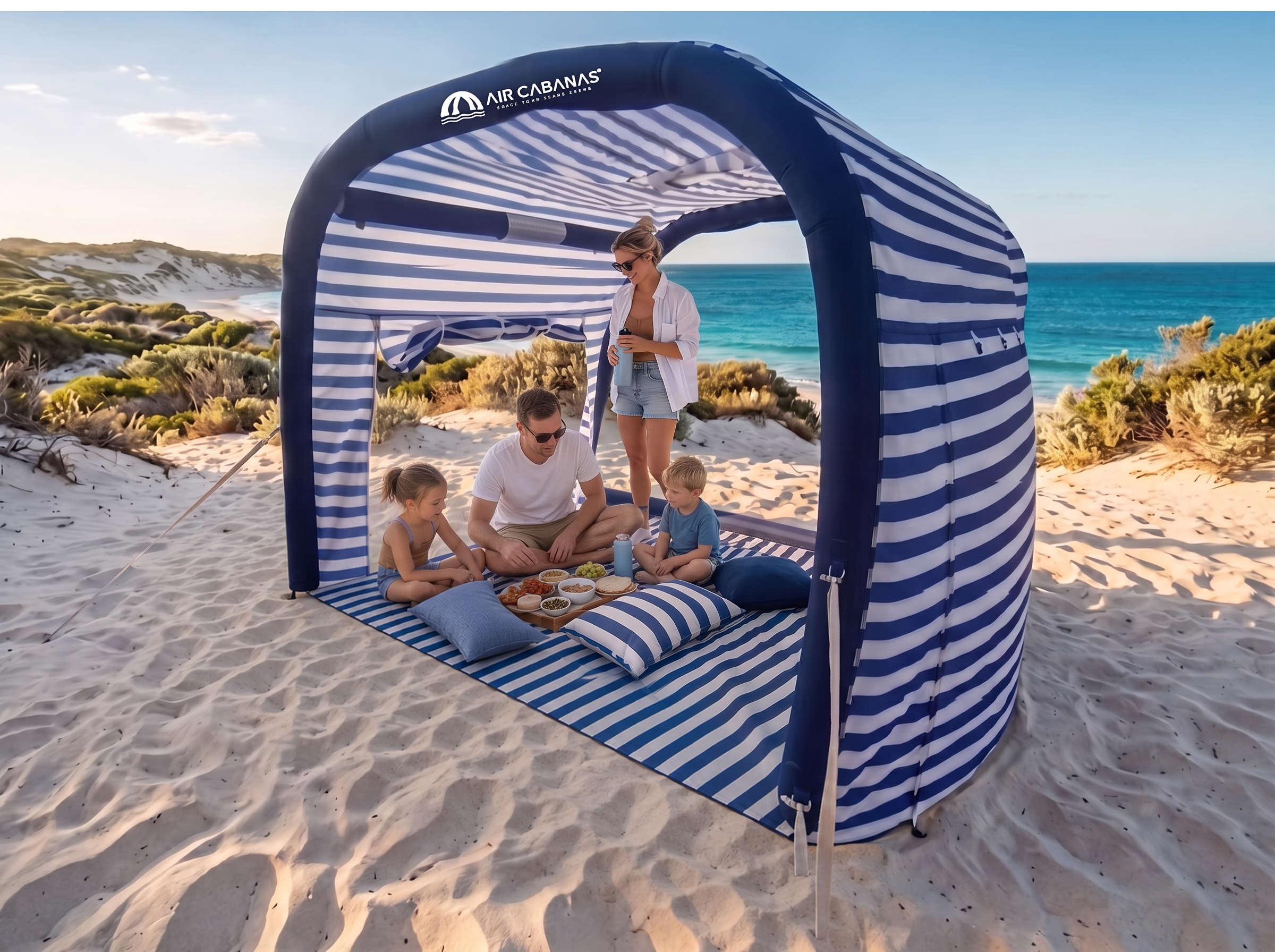
When families seek a cool cabana experience without the attendant anxiety of metal poles, frameless inflatable shelters provide a radically safer alternative. The AirCabana design replaces sharp central spears and rigid perimeter struts with pressurized, heavy-duty TPU air bladders encased in durable marine-grade fabric. If unexpected gusts test the limits of your setup, there are no pointed metal stakes waiting to spear a passing toddler, no pinched fingers from rusty locking pins, and no airborne metal bars tumbling toward neighbouring sunbathers.
Moreover, eliminating metal frames dramatically simplifies the physical interaction between users and their gear. Packing down a conventional pole-frame cabana during an unexpected squall often turns into an unruly wrestling match with recalcitrant metal joints and flapping fabric. An air-tube shelter, by contrast, deflates smoothly in seconds via high-flow valves. By removing high-mass rigid components from the coastal environment, beachgoers drastically reduce their personal liability and protect their loved ones from the documented perils of airborne beach hardware.
Why Frameless Shade Eliminates the Primary Beach Umbrella Danger
The core advantage of eliminating metal stems from basic physics: without mass and hardness, you eliminate projectile danger. Frameless shade structures distribute wind resistance across an integrated, soft-profile architecture rather than focusing immense shear stress onto a single central pole. In an AirCabana, the four-legged archway design funnels air naturally while maintaining tension through inflated structural beams. This soft geometry completely eradicates the single most catastrophic beach umbrella danger—the spear-like projectile pole that drives trauma statistics worldwide.
In addition to structural softness, the anchoring philosophy of frameless air-tube shelters is fundamentally superior for sandy environments. Rather than relying on friction along a narrow cylinder driven into sand, modern frameless cabanas utilise multiple wide-mouth sand pockets positioned at every corner. These sandbags harness the weight of the beach itself—often forty to fifty kilograms of wet or dry sand—to pin the shelter firmly to the ground. This creates a low centre of gravity that works in harmony with the terrain rather than fighting against it.
Even in the event that an extreme squall overcomes the setup, the failure mode of an inflatable cabana is gentle and benign. Instead of launching violently skyward like an inverted metal canopy, an air-beam structure merely deforms or gently rolls without sharp edges or heavy impact points. For parents keeping a watchful eye on small children running between the waves and the towel, having a shade shelter devoid of hazardous metal components delivers invaluable peace of mind during long coastal afternoons.
Best Practices for Beachgoers: Anchoring, Supervision, and Pack-Down
Regardless of the shade system you choose, proper coastal safety begins with proactive habits and situational awareness. No beach shade is entirely invincible against the raw power of nature, and no cabana should ever be left unattended in deteriorating conditions. Whenever you arrive at the beach, take a moment to assess the wind direction, wave swell, and tide line. Setting up your shelter behind natural windbreaks, such as low dunes or patrolled flagged zones, significantly reduces baseline aerodynamic strain on your equipment.
When pitching an air-tube shelter like the AirCabana, maximizing your ballast is essential for complete stability. Always take the extra sixty seconds to completely fill every built-in sand pocket to its absolute brim. Using damp sand from slightly below the dry surface layer dramatically increases anchor mass and prevents pocket creep. Ensure all structural air beams are inflated to their recommended operational firmness so that the framework maintains its self-supporting tension without buckling under typical coastal sea breezes.
Most importantly, beachgoers must cultivate the discipline to pack down early when weather conditions deteriorate. If coastal winds begin whipping whitecaps across the water, blowing sand along the shore, or threatening the structural integrity of your setup, it is time to take your shade down. Continuous supervision is non-negotiable; never leave a fully pitched cabana unattended while your entire group swims or walks away. Taking collective responsibility for our beach equipment preserves the safety and relaxed beauty of Australia's shared coastal spaces.
Frequently asked questions
Here are clear answers to the most common questions Australians ask about coastal shade hazards, wind safety, and modern cabana alternatives.
Why are beach umbrellas dangerous in the wind?
Traditional beach umbrellas feature large, curved canopies anchored by a single narrow central pole driven into soft sand. Strong coastal gusts get trapped underneath the canopy, creating massive aerodynamic lift that easily dislodges the pole. Once airborne, the sharp metal ribs and pointed spike transform the umbrella into a dangerous projectile that can cause severe blunt trauma or lacerations to beachgoers downwind.
What is the safest shade to use at the beach?
Frameless air-tube cabanas are widely considered the safest shade alternative for coastal environments. By replacing heavy steel or aluminium frames with soft, inflatable TPU air beams and utilizing high-capacity sand ballast pockets at every corner, designs like the AirCabana eliminate sharp projectile points, resist wind rollover, and provide extensive sun protection without rigid metal hazards.
Can a beach umbrella cause serious eye injuries?
Yes. Medical journals across Australia and internationally frequently document severe ocular trauma resulting from rogue beach umbrellas. The thin, rigid metal spokes of tumbling umbrellas concentrate kinetic energy onto a tiny area, which can cause corneal lacerations, hyphema, or permanent blindness upon impact. Soft, frameless shade options eliminate these exposed metal spokes entirely.
How do you stop a beach cabana from blowing away?
To stop your cabana from blowing away, always orient the entrance away from oncoming gusts and fill every corner ballast pocket completely with damp sand. For inflatable shelters, ensure air beams are pumped to full firmness. Always supervise your setup continuously, and proactively pack it down immediately if wind gusts begin lifting the anchor corners or causing structural instability.
Are inflatable cabanas safer than traditional pole cabanas?
Inflatable cabanas are significantly safer because they completely remove rigid metal poles and mechanical pinch points from the equation. If an unexpected squall causes an inflatable structure to shift, its flexible air-filled tubes cushion impact rather than inflicting blunt-force trauma. Furthermore, their integrated multi-point sand anchoring provides far greater stability than single-pole parasols.