Beach Tent Ventilation: Why Airflow Beats Extra Fabric
Discover why beach tent ventilation beats heavy fabric. Learn how apex vents and roll-up mesh sides stop heat build-up under the hot Australian sun.
Published 2026-10-21T20:01:31.448+00:00
Stepping off the scorching sand into coastal shade should bring instant relief, yet many Australians discover that their shelter feels more like a greenhouse than a sanctuary. Choosing the right beach tent ventilation is far more important than piling on extra layers of heavy fabric. When solar radiation beats down on the coast, solid panels trap stagnant air and cause suffocating heat build-up. By understanding how airflow, roof venting, and breathable mesh work together, you can create a breezy, sun-safe haven that keeps your family genuinely comfortable all summer long.
The Physics of Heat Build-Up Under Beach Canopies
Australian summer days on the coast are legendary, but anyone who has crawled inside an enclosed beach shelter at midday knows the sensation of entering a fabric sauna. When solar radiation strikes overhead fabric, the material absorbs radiant energy and reradiates it downwards into the sheltered zone. Without adequate beach tent ventilation, that thermal energy becomes trapped, creating localized microclimates where temperatures under the canopy regularly climb significantly higher than the ambient air outside.
This phenomenon is driven by radiant heat and basic thermodynamics. Dense polyester or nylon weaves, especially those coated with heavy dark silver lining compounds to achieve high UPF ratings, can inadvertently block thermal exchange. While high-grade coatings are essential for blocking harmful ultraviolet rays, solid impenetrable fabric walls prevent stagnant hot air from escaping. The trapped air absorbs body heat, reflected radiant warmth off the white sand, and the convective heat radiating off the sun-baked fabric overhead.
Understanding heat build-up changes how you evaluate coastal shade. Simply buying a shelter with maximum fabric coverage, such as three fully enclosed solid walls and a deep awning, often creates a thermal pocket with virtually zero air circulation. The heat continues to compound throughout the morning as the sun climbs higher. To stay genuinely comfortable on hot coastal days, shade must work in harmony with the sea breeze rather than acting as a solid barrier that suffocates the interior space.
Why Beach Tent Ventilation Trumps Total Fabric Coverage
There is an intuitive assumption among many beachgoers that more fabric automatically yields superior protection. Families often seek out expansive, three-sided dome tents or heavily curtained cabanas, believing that boxing themselves in will shield them from the scorching Australian sun. However, comprehensive testing and coastal reality reveal that effective beach tent ventilation provides a vastly cooler, healthier environment than enveloping yourself in extra square metres of heavy synthetic textile.
When you sit under a shelter with poor air exchange, your body's primary cooling mechanism—evaporative sweat cooling—is almost entirely neutralized. The trapped interior air quickly reaches high relative humidity as sweat evaporates from your skin into a confined space with nowhere to dissipate. In contrast, an open, well-ventilated canopy allows continuous coastal air circulation, whisking away humid micro-pockets and letting your skin cool naturally through continuous convection, even during sweltering January heatwaves.
Furthermore, excessive fabric acts as a colossal wind catch. On typical Australian beaches where afternoon sea breezes sweep across open sand, solid walls catch coastal gusts like a ship's mainsail. This aerodynamic drag places immense mechanical stress on anchor points, guy lines, and frame structures. By prioritizing strategic ventilation channels rather than sheer wall area, you not only drop the perceived temperature beneath the roof, but you also drastically reduce structural drag, helping your shelter sit stably on the sand while others buckle and strain.
The Critical Role of Apex Vents in Hot Weather
Hot air behaves according to fundamental natural laws: as air warms, its molecules expand, its density decreases, and it rises toward the highest available point. In a standard peaked shelter without rooftop relief, this superheated air gathers in the ceiling crown, creating a persistent blanket of heat right above your head. Apex vents solve this fundamental engineering challenge by providing a dedicated escape hatch at the very summit of the canopy structure.
As coastal breezes flow across the external apex of your shelter, they generate a localized low-pressure zone directly above the roof vents—an application of Bernoulli's principle. This negative pressure actively pulls the trapped, rising warm air up and out of the interior, creating a chimney effect that continually siphons hot air away from the occupants seated below. Shelters that omit apex vents inadvertently force that rising heat to pool and radiate back down onto your scalp, completely undermining the cooling benefit of overhead shade.
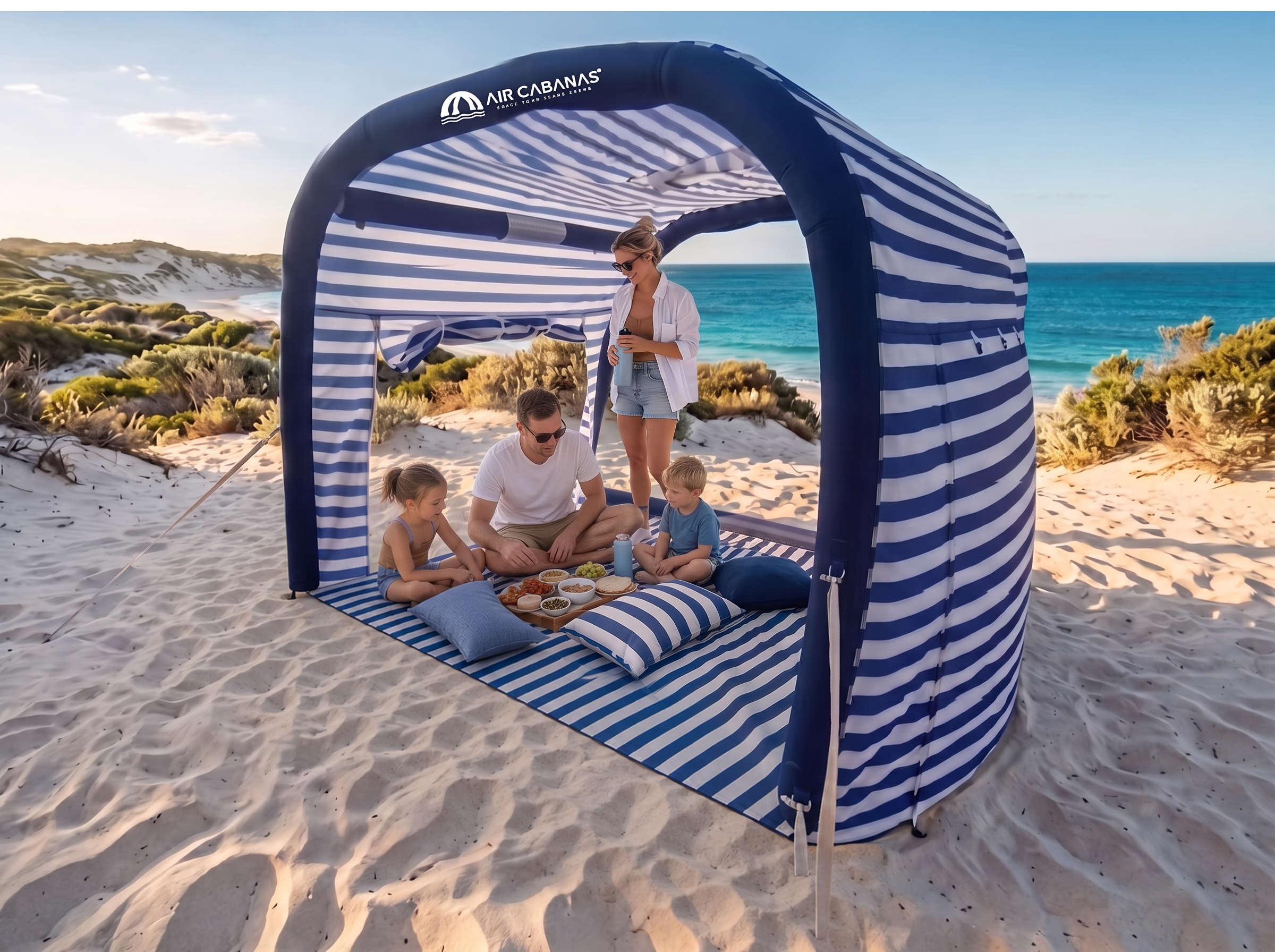
Modern inflatable shade designs, such as the AirCabana, integrate this natural convective cycle directly into their architectural profile. Rather than wrestling with heavy, solid rooftop panels, having built-in apex vents ensures that even on days with minimal surface wind, natural thermal convection keeps air circulating continuously through the shelter. When considering any coastal sun shelter, examining whether the roof design incorporates genuine, unobstructed ceiling vents is one of the most reliable indicators of how cool you will actually remain during an Australian summer midday.
Roll-Up Mesh Sides: Balances of Privacy and Airflow
While an open canopy provides peerless ventilation, Australian beachgoers often desire flexibility for privacy, napping infants, or shielding gear from low-angle afternoon sun. This is where roll-up mesh sides provide the ultimate balance between thermal airflow and physical coverage. Unlike solid non-breathable polyester side panels that act like windbreaks and heat traps, finely woven marine-grade mesh creates an effective shade barrier that still lets coastal breezes pass straight through.
The beauty of roll-up mesh sides lies in their modular versatility throughout a long beach day. During early morning hours when the breeze is light and the sun sits low on the horizon, you can leave the panels secured to intercept blinding glare. As the midday sun climbs directly overhead and temperatures spike, rolling up the panels completely opens the perimeter to full 360-degree cross breezes. If the wind picks up and begins whipping dry sand along the surface, dropping a mesh screen stops drifting grit while maintaining continuous beach tent ventilation.
Choosing shelters with intuitive tie-backs and durable toggles ensures you can reconfigure your setup in seconds without fighting sticky zippers clogged with coastal grit. Quality mesh screens also diffuse harsh glare without plunging the interior into gloomy darkness, maintaining an inviting, light-filled sanctuary. By utilizing roll-up mesh sides rather than rigid, solid walls, you maintain total control over your coastal environment, adapting effortlessly to shifting sun angles and changing wind directions without suffocating inside a dark fabric cave.
Engineering Superior Beach Tent Ventilation with Inflatable Technology
Traditional shade structures on Australian beaches have long been dominated by heavy metal or plastic frames. Generic pole-frame cabanas, while widely recognizable, rely on rigid central shafts and cross-arms that can complicate overhead airflow channels and restrict how fabric ceilings flex in the wind. The evolution of modern air-tube cabana architecture, pioneered by AirCabana, takes a completely different path by utilizing pressurized structural beams that eliminate internal clutter and maximize unimpeded internal volume.
Without rigid horizontal metal ribs spanning the interior roof space, an inflatable shelter provides a clean, open ceiling vault that accelerates the upward movement of hot air directly toward high-level exhaust openings. The supple, robust nature of high-pressure air tubes allows the canopy to yield dynamically to gusts rather than shuddering rigidly, maintaining smooth laminar airflow across and through the structure. This architectural clarity transforms beach tent ventilation from an afterthought into the primary structural foundation of the shelter.
In addition, an air-tube cabana can be rapidly erected with an included high-capacity pump in mere minutes, meaning you spend less time sweating over tangled metal poles and more time relaxing in ventilated comfort. The AirCabana design replaces fragile mechanical joints with seamless, puncture-resistant air chambers, pairing heavy-duty UPF 50+ canopy textiles with expansive perimeter entry points. The result is an airy, cool cabana experience that feels open to the ocean view while insulating your family from intense solar radiation.
Best Practices for Maximizing Breeze and Shelter Stability
Even the most meticulously engineered beach tent ventilation system requires thoughtful on-sand orientation to perform at its peak. When arriving at the beach, take a brief moment to observe the local wind patterns by watching the surf spray or flags. Always position the primary open face or dedicated intake side of your canopy directly into the prevailing onshore sea breeze, allowing fresh oceanic air to enter unobstructed and sweep across your seating area before venting out the rear and apex.
Proper anchoring is the bedrock of coastal safety and ventilation efficiency. A loose, flapping canopy disrupts smooth airflow channels and poses an immediate hazard to surrounding beachgoers. Always bury your sand pockets deeply into moist sand beneath the dry surface layer, as damp compacted sand provides vastly superior holding power compared to loose surface powder. If your shelter includes adjustable guy lines, peg them out at 45-degree angles using specialized spiral sand pegs to keep the canopy taut and aerodynamic.
It is vital to recognize that no fabric canopy or air cabana is wind-proof. Australian coastal weather is famously dynamic, and calm morning skies can rapidly give way to severe southeasterly busters or squalls. Never leave any beach shelter unattended, supervise children at all times around anchor ropes, and always proactively pack down your shelter if conditions become unpredictable, turbulent, or unsafe. Correct anchoring and common-sense vigilance ensure your ventilated shelter remains a safe, relaxing haven for your entire family all summer long.
Frequently asked questions
Here are answers to the most common questions Australians search when choosing between ventilated beach tents and enclosed shade shelters.
Does beach tent ventilation really make a difference to temperature?
Yes, significantly. Proper beach tent ventilation prevents superheated air from becoming trapped beneath the canopy ceiling. By combining open perimeter entries with roof vents, hot air continuously vents outward through natural convection. This steady airflow can make the perceived temperature underneath the shelter feel noticeably cooler compared to an enclosed, poorly ventilated fabric tent on hot Australian summer days.
Are open cabanas better than enclosed beach tents for families?
For typical Australian summer beach days, open cabanas are generally much better than fully enclosed dome tents. Open designs promote continuous coastal airflow, preventing rapid heat build-up and stuffiness. They also provide unobstructed 360-degree sightlines so parents can keep a constant eye on children swimming in the surf, all while avoiding the oven-like atmosphere common to enclosed nylon shelters.
How do apex vents work on beach shelters?
Apex vents exploit the natural thermodynamic principle that hot air rises. As sunshine warms the air beneath the canopy, the superheated air ascends to the peak of the roof. An apex vent provides a direct exhaust opening at the highest structural point, allowing hot air to escape freely while drawing in cooler sea breezes from below to maintain steady air exchange.
Will roll-up mesh sides keep the wind and sand out?
Roll-up mesh sides effectively filter blowing sand and soften strong coastal breezes without completely blocking the cooling airflow. Unlike solid polyester walls that act like sails and cause severe turbulence, fine marine-grade mesh diffuses gusts, protects personal belongings from surface grit, and provides pleasant sun shading while still allowing refreshing ventilation to flow through.
Can an inflatable air cabana withstand coastal wind?
An air-tube cabana flexes dynamically with coastal gusts rather than snapping or bending like rigid pole-frame cabanas. When all sand pockets are fully buried in damp sand and guy lines are firmly secured, the structure offers outstanding stability. However, no beach shelter is wind-proof, so you should always supervise your setup and pack down immediately in unsafe, storm-prone conditions.