Beach Sun Shade Buying Guide: What Works on Sand
Looking for the best beach sun shade in Australia? Our complete buyer guide covers UPF ratings, anchoring on sand, packed weight, and wind stability.
Published 2026-11-03T20:00:39.333+00:00
Finding the ultimate beach sun shade in Australia is essential for anyone who loves spending long summer days by the ocean without ending up sunburnt or wrestling with blown-away gear. With brutal UV levels and gusty coastal breezes, standard outdoor shelters often fail within minutes of setting up on soft sand. Whether you are searching for a lightweight canopy for quick ocean swims or a spacious family shelter for all-day coastal camping, this comprehensive buyer guide explains what actually works on Australian sand—from certified sun protection to rock-solid anchoring and packable designs.
Why Choosing the Right Beach Sun Shade Matters on Australian Coastlines
Spending a summer afternoon along the Australian coast requires serious preparation, and selecting the right beach sun shade is often the difference between an idyllic family outing and a stressful battle against the elements. Our coastal environments present unique challenges that standard garden shelters simply cannot handle. Between harsh UV levels, shifting tides, coarse coastal sand, and relentless afternoon sea breezes, your seaside shelter needs to be engineered specifically for our local shorelines. Too many beachgoers end up with bent metal poles, shredded fabric, or runaway umbrellas before lunchtime.
The reality of Australian beach culture is that we stay outdoors for hours. Whether you are setting up camp on the sun-baked sands of Queensland’s Sunshine Coast, enduring the brisk southerlies along Sydney’s Eastern Suburbs, or spending all day on Perth’s open beaches, your shelter must deliver consistent comfort. A poorly chosen shelter turns into a dangerous projectile the moment a gust sweeps across the dunes. Understanding how sand mechanics and wind interact with different shelter profiles ensures you invest in gear that stands firm rather than collapsing under pressure.
Modern beachgoers now have access to sophisticated outdoor equipment engineered to withstand open-air coastal conditions. Rather than wrestling with flimsy wire frames or heavy, rust-prone metal assemblies, Australians are looking for durable materials that balance stability, convenience, and protective performance. By taking the time to evaluate core features such as fabric technology, anchor systems, and ease of assembly, you can secure an outdoor setup that elevates every seaside weekend for seasons to come.
Understanding the Demands of Australian Sand and Salt Air
Marine environments are inherently abrasive. Airborne sea salt rapidly corrodes cheap metal joints, hinges, and steel eyelets, causing moving mechanisms to seize up after just a couple of trips to the beach. Meanwhile, fine quartz sand finds its way into every screw thread and telescopic joint, grinding components down over time.
A truly capable beach shelter must be constructed with non-corrosive materials and rugged stitching that can endure constant exposure to salt water spray and fine grit. Without durable, salt-resistant components, even an expensive shade structure will quickly deteriorate, leaving you looking for a replacement halfway through summer.
UPF Ratings and Fabric Technology: Real Sun Protection on the Sand
When evaluating any beach sun shade, the fabric specification should be your first consideration. In Australia, where ambient solar radiation is exceptionally high, standard decorative canvas or ultra-thin nylon canopies offer little more than psychological relief. Independent laboratory certification under Australian standards provides the only reliable baseline for true ultraviolet defence. High-quality canopies must block both UVA and UVB rays effectively, ensuring that anyone resting underneath remains shielded throughout the hottest hours of the day.
A verified rating of UPF 50+ is the gold standard for Australian conditions, reflecting fabric capable of blocking at least ninety-eight percent of harmful ultraviolet radiation. However, high-density fabric alone does not tell the whole story. The weave, coating, and colour of the material all play major roles in how heat transfers beneath the roofline. Darker underside coatings reduce ambient glare bouncing off white coastal sand, which dramatically decreases eye fatigue and keeps the shaded microclimate substantially cooler.
Furthermore, premium shelters employ woven polyester or ripstop textiles treated with durable water repellent finishes. These fabrics resist mildew when packed away damp and prevent water saturation during unexpected coastal squalls. Investing in heavy-duty, UV-stabilised canopy material ensures the shelter will not bleach, thin out, or degrade after a single season under the blazing southern sun.
Why Ground Radiation Demands Comprehensive Coverage
Many beachgoers underestimate the impact of ground-reflected radiation. Dry coastal sand can reflect up to fifteen percent of UV rays directly back up under your canopy, meaning a small overhead disk provides inadequate biological protection.
Achieving genuine sun safety requires deep, downward-angled rooflines or generous side drops that intercept angled light. Broad overhead surface area creates a cooler shadow zone, shielding delicate skin from indirect reflections and ensuring children can play safely away from direct sun exposure.
Anchoring Systems: How to Keep Your Shade Secure in Loose Sand
No matter how advanced your canopy fabric is, a beach sun shade is only as dependable as its foundation. Sand is an incredibly dynamic substrate; surface sand shifts constantly with the breeze, while deeper sand holds moisture and density. Traditional thin metal stakes designed for firm turf pull out effortlessly under the slightest lateral wind pressure. To secure a shelter on the beach, you must use anchoring systems purpose-built to harness the weight of the sand itself.
Corner ballast pockets remain one of the most effective methods for coastal stability. By filling oversized fabric bags with damp sand at each corner, you anchor the structure using forty to sixty kilograms of deadweight directly on the sand surface. This ballast counteracts the upward aerodynamic lift generated when coastal breezes blow across the canopy. For setups requiring extra support in gusty conditions, wide-flanged helical screw pegs or buried fabric parachutes provide exceptional holding power by engaging deeper, compacted sand layers.
Correct technique makes all the difference when setting up on sand. Experienced beachgoers always position their shelter facing squarely into the prevailing wind to prevent buffeting, ensuring corner pockets are packed completely full of damp sand before raising the roofline. Regardless of how well anchored your setup feels, you must never leave any shade structure unattended on an open beach, and you should always pack it down if conditions become hazardous.
The Superiority of Gravity-Based Sand Bags
Rigid ground stakes rely purely on soil friction, which rapidly fails as loose sand vibrates under gusty winds. Sand bags, by contrast, rely on pure gravitational mass, meaning they do not work loose or pop out when wind speeds fluctuate along the water.
Using integrated sand ballast pockets also eliminates sharp metal hazards around your campsite. When it is time to pack up, simply untie or invert the pockets to empty the sand cleanly back onto the beach without leaving holes or litter behind.
Comparing Shelter Types: Inflatable Cabanas vs Pole-Frame Cabanas
Choosing the right beach sun shade category comes down to finding the ideal balance between structural stability, packability, and simplicity of assembly. For decades, Australian beaches were dominated by simple beach umbrellas, but their tiny shade footprints and tendency to turn inside out have pushed families toward more substantial cabana-style shelters. Within the modern market, the primary choice now sits between traditional pole-frame cabanas and innovative inflatable air-tube shelters.
Traditional pole-frame cabanas rely on a rigid central mast supported by folding metal or fibreglass arms that spread the fabric outward into a square cool cabana footprint. While these offer a familiar silhouette and reasonable stability when anchored thoroughly, their metal components introduce several mechanical vulnerabilities. Salt air easily corrodes locking pins, wind gusts can bend or snap cross-arms, and pinching your fingers in metal folding hinges is an all-too-common frustration when packing down on a windy shoreline.
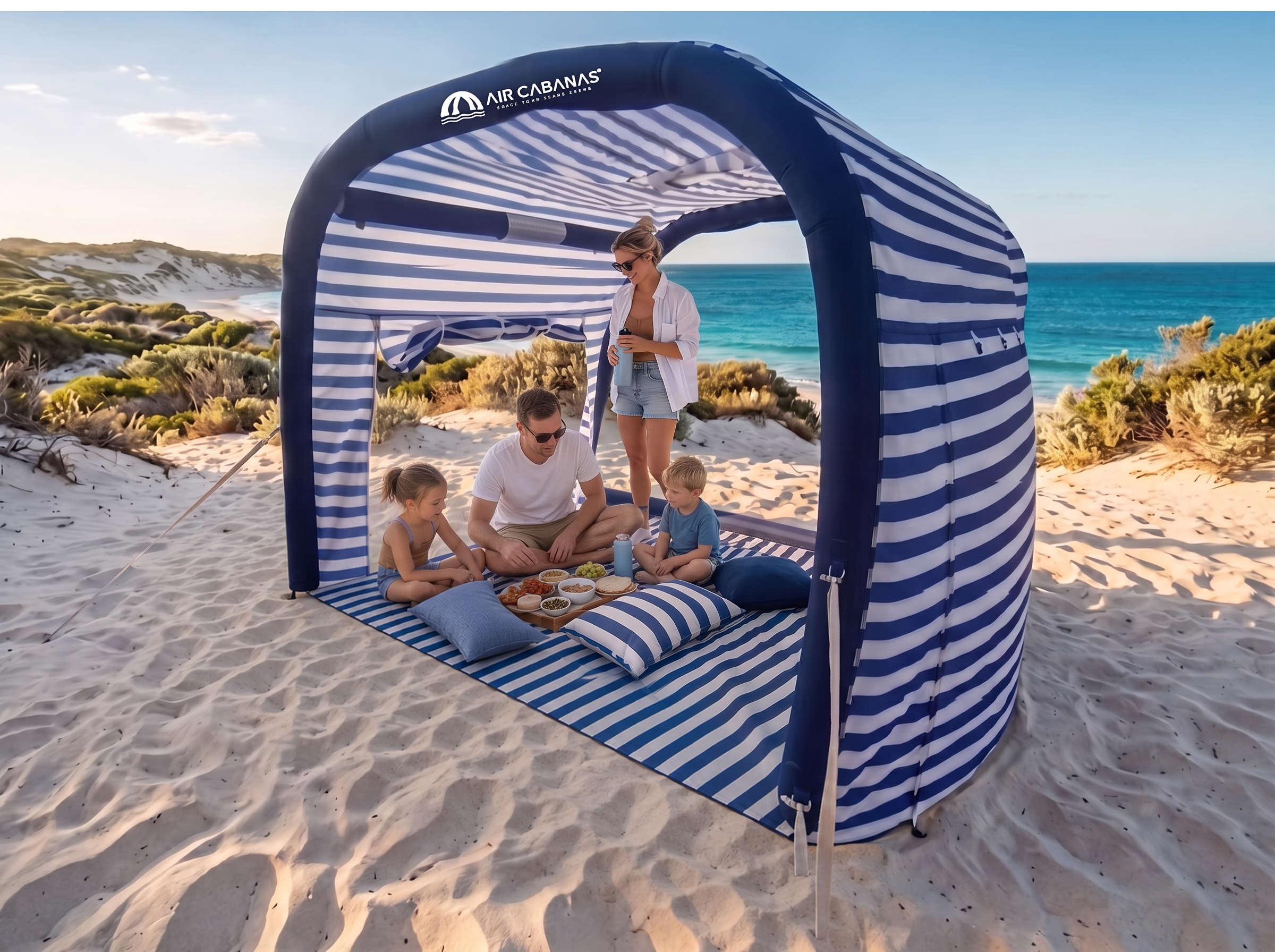
In contrast, inflatable shelters like the AirCabana utilise high-pressure air beams in place of rigid framework. By replacing metal poles with puncture-resistant, marine-grade air tubes, an air cabana eliminates bent frames, snapped hinges, and jammed telescopic sections entirely. The structure naturally flexes under wind pressure, absorbs aerodynamic energy without structural damage, and pops straight back into shape when the gust passes, offering unmatched safety and hassle-free operation for beach-loving families.
The Realities of Wind Flex and Frame Longevity
Rigid pole-frame cabanas transfer every ounce of wind load directly into their mechanical joints and weld points. Over several summers, this continuous stress leads to structural fatigue, loose rivets, and ultimately bent or broken metal struts that render the shelter unusable.
An aircabana avoids mechanical fatigue completely by using dynamic pneumatic pressure. Because the structural ribs are flexible, they bend harmlessly with the breeze rather than resisting it until failure occurs, ensuring long-term durability and peace of mind on gusty coastal shorelines.
Footprint, Usable Space, and Packed Weight Considerations
When evaluating practical shelter design, footprint and packed weight are two critical specifications that dictate how often you will actually use your gear. A shelter needs to be expansive enough to cover your entire crew, their beach chairs, and eskies, yet sufficiently compact and lightweight to carry across soft sand dunes alongside boogie boards and towels. Overly heavy or cumbersome equipment often ends up gathering dust in the garage after the novelty wears off.
The internal usable space of your beach sun shade is heavily influenced by its structural architecture. Traditional center-pole designs obstruct the middle of your camp, forcing your family to sit around the pole and reducing usable floor space. Modern open-span designs, including the AirCabana Classic and AirCabana Family, eliminate central obstructions entirely. This allows you to position large picnic blankets, reclining loungers, and surfboards across the full span without bumping into metal uprights.
Equally vital is the packed weight of the complete kit. Walking through deep sand on a scorching thirty-degree day with an awkwardly balanced, heavy bag is exhausting. High-quality shelters utilise lightweight ripstop textiles and efficient structural designs that keep the overall carry weight between four and six kilograms. Look for wide, padded shoulder carry bags with heavy-duty zips that make the walk from the carpark to the water’s edge effortless for a single person.
Matching Shelter Footprint to Family Size
A compact footprint of roughly two by two metres is generally ideal for couples or solo beachgoers needing an agile setup that occupies minimal space on busy city beaches. It sets up rapidly and packs down into an exceptionally small carry profile.
For larger families or groups spending full days on the sand, stepping up to a larger footprint provides the essential square footage required to keep multiple children, picnic gear, and beach bags safely out of the direct sun all afternoon.
Step-by-Step Maintenance and Care for Long-Lasting Beach Gear
Even the highest quality beach sun shade requires sensible care to maintain its structural integrity and fabric performance over multiple seasons. The combination of intense ultraviolet rays, salt crusting, and micro-abrasive sand will eventually degrade any outdoor gear if it is routinely packed away dirty and forgotten until the next summer holiday. Implementing a simple post-beach care routine takes only minutes and extends the lifespan of your shelter by years.
The golden rule of coastal gear maintenance is never to store your shelter damp or caked in salt. When you return home from the beach, take a garden hose and thoroughly rinse the canopy, corner ballast pockets, and structural tubes with fresh water. Fresh water dissolves corrosive salt crystals and washes away fine sand trapped within seams and fabric folds. Always hang your shelter in a shaded, well-ventilated area until it is completely dry before packing it away in its carry bag.
Storing your shelter bone-dry prevents the growth of unsightly black mould and stops the polyurethane waterproof coatings from breaking down prematurely through hydrolysis. In addition, periodically inspect tie-down cords and seams for signs of fraying or wear. Giving your equipment proper attention ensures that when the next sunny weekend rolls around, your shelter is fresh, clean, and ready to perform effortlessly on the sand.
Handling Sand Removal Efficiently at the Beach
Before rolling up your canopy on the beach, shake each corner vigorously to dislodge fine sand from ballast pockets and seams. Never force a zipper closed over impacted sand; brush teeth clear using a small hand broom or towel to prevent stripped zips.
Avoid rolling damp canvas directly into hot car boots for extended periods. Allowing equipment to bake in high vehicle temperatures weakens fabric coatings and can warp synthetic parts, so unpack and air out your gear as soon as you arrive home.
Frequently asked questions
Here are straightforward answers to the most common questions Australians ask when buying and using beach shades.
What is the best beach sun shade for windy conditions?
The best beach shelter for windy conditions is one that combines deep sand ballast pockets with flexible structural elements rather than brittle poles. Inflatable air-tube cabanas like AirCabana excel because they flex with wind gusts and rebound without snapping metal joints. Always position your shelter facing into the wind and pack down if conditions become severe.
Are inflatable beach cabanas better than metal pole cabanas?
Yes, inflatable beach cabanas offer significant advantages over traditional pole-frame cabanas. By using high-pressure air beams instead of rigid steel or aluminium poles, an air cabana eliminates pinch points, bent frames, and rust from salt spray. They are lighter to carry, faster to pitch with a pump, and pack down into a compact bag.
What UPF rating should I look for in an Australian beach shelter?
You should always look for a certified UPF 50+ rating when buying a shelter in Australia. This independent rating ensures the canopy fabric blocks at least 98 percent of harmful UVA and UVB radiation, providing the high level of sun protection required to prevent sunburn during extended days outdoors.
How do you stop a beach sun shade from blowing away?
To stop your shelter blowing away, fill all corner ballast pockets completely with damp sand, which is denser and heavier than dry surface sand. Angle your shelter into the prevailing sea breeze, bury anchors deep into compacted sand layers, and never leave an open canopy unattended on a windy beach.
How much should a good beach cabana weigh to carry easily?
A practical beach cabana should have a packed weight between 4 and 6 kilograms. This weight range provides heavy-duty, wind-resistant materials and robust fabric without making the walk from the carpark across soft sand dunes exhausting for parents carrying towels, eskies, and children's beach gear.