Beach Shade Skin Cancer Prevention: Essential Australian Guide
Learn why beach shade skin cancer prevention is vital in Australia. Discover Cancer Council-aligned shade guidance, UV index habits, and safe canopy design.
Published 2026-10-20T20:01:30.308+00:00
Australia boasts some of the most spectacular coastlines in the world, yet spending time by the ocean requires serious respect for our harsh solar climate. Understanding the critical role of beach shade skin cancer prevention enables coastal families to embrace the ocean lifestyle without compromising long-term dermatological health. With ultraviolet radiation reaching extreme levels across southern summers, establishing a reliable, high-protection base camp on the sand is not just a comfort—it is an indispensable defense. By combining sensible shelter design with evidence-based sun habits, you can protect your loved ones while making unforgettable seaside memories.
Why Beach Shade and Skin Cancer Prevention Matter in Australia
Australia records some of the highest levels of solar ultraviolet radiation on earth, making sun defence an essential part of coastal living. When spending long summer afternoons along the coastline, relying on a slap of sunscreen alone rarely offers adequate coverage. Understanding the relationship between beach shade skin cancer prevention and cumulative solar exposure helps beachgoers protect their skin over a lifetime while still enjoying the surf, sand, and outdoor lifestyle.
Ultraviolet radiation cannot be seen or felt, which often catches swimmers and sunbathers off guard during warm coastal days. High ambient temperatures do not dictate UV intensity; clear spring mornings and breezy summer afternoons often carry extreme radiation loads capable of causing cellular skin damage within fifteen minutes. Establishing consistent sun protection measures reduces the risk of melanoma and non-melanoma skin cancers, which continue to place a heavy burden on Australian families each year.
Physical shelter forms the foundation of smart sun management. While personal sunscreens, rash vests, and wide-brimmed hats shield individuals as they move about, a reliable base camp allows everyone to step entirely out of direct solar rays. By positioning high-quality shelter between your family and the sky, you minimise direct UV assault, dramatically lowering overall cellular radiation accumulation during hours of peak ambient sunlight.
The Australian UV Reality on Coastal Sands
Coastal environments present unique environmental factors that amplify ultraviolet intensity compared to inland parks. Fine white sand acts like a pale mirror, scattering solar rays upward beneath hats and sunglasses, while ocean foam and breaking waves create diffuse reflection across open shorelines. Consequently, a family sitting by the water receives solar radiation from multiple angles simultaneously.
This intense environmental scatter means partial protection simply leaves skin vulnerable to indirect burns and deep dermal damage. Creating a broad overhead canopy with expansive downward coverage intercepts direct rays before they bounce off wet sand, ensuring everyone resting between ocean swims remains shielded from concentrated midday overhead exposure.
Aligning Beach Shade Skin Cancer Safety with Cancer Council Guidance
Public health guidelines in Australia consistently highlight the importance of multi-layered sun defence, emphasising that shade functions best as part of a complete strategy rather than an isolated tool. Cancer Council-aligned shade guidance stresses combining physical shelter with broad-brimmed hats, protective UPF 50+ clothing, wrap-around sunglasses, and broad-spectrum sunscreen applied every two hours. Relying on any single layer creates a false sense of security that can lead to unexpected burns.
When choosing beach shelters, fabric rating and physical geometry make a measurable difference to your family's safety. Cheap novelty umbrellas and loosely woven pop-ups frequently let harmful rays filter through thin synthetic fabrics, offering minimal defence against cellular damage. Selecting shelters engineered with dense UPF 50+ woven textiles ensures that the overarching canopy blocks at least ninety-eight percent of direct ultraviolet radiation from penetrating the fabric overhead.
Furthermore, the physical dimensions of the canopy determine how effectively it protects against diffuse radiation entering from the sides. Deep, expansive overhead coverage creates a substantial shadow footprint that keeps children and adults centered safely away from angled peripheral light. Pairing dense protective canopies with routine sunscreen reapplication delivers comprehensive, multi-layered coverage aligned with proven public health principles.
Understanding Daily UV Index Habits for Coastal Outings
Forming proactive UV index habits before packing the car ensures you never get caught unprepared by deceptive coastal conditions. The Global Solar UV Index measures the strength of sunburn-producing ultraviolet radiation on a scale from zero upward, with readings of three or higher requiring sun protection. Across most Australian coastlines between September and April, the index routinely reaches extreme levels of eleven or greater by late morning.
Many beachgoers mistakenly assume that cool sea breezes or light cloud cover provide natural insulation from solar damage. Clouds attenuate infrared heat, creating a pleasant, deceptive sensation, yet up to eighty percent of ultraviolet radiation easily penetrates overcast skies. By checking your daily weather app for the hourly UV forecast, you can plan water activities for lower-risk morning hours and retreat beneath generous shelter during peak midday danger periods.
Consistency transforms simple awareness into lifelong skin preservation. Monitoring how the sun moves across your favourite sandy cove allows you to reposition your beach shelter or adjust internal seating as shadows shift. Teaching younger family members to associate stepping onto the sand with establishing shade and slipping on rashies builds sustainable habits that shield their skin for decades to come.
Comparing Shelter Architecture: Inflatable Air-Tube vs Pole-Frame Cabanas
Coastal sun lovers historically relied on metal-jointed pole-frame cabanas to escape the harsh midday sun. While these traditional structures offer overhead fabric, their rigid steel and aluminium frameworks introduce notable safety hazards when seaside gusts whip across the surf. Stiff metal uprights, sharp guy-wire pins, and brittle plastic joints can buckle under wind pressure, transforming a relaxing beach outing into a stressful scramble to catch airborne poles.
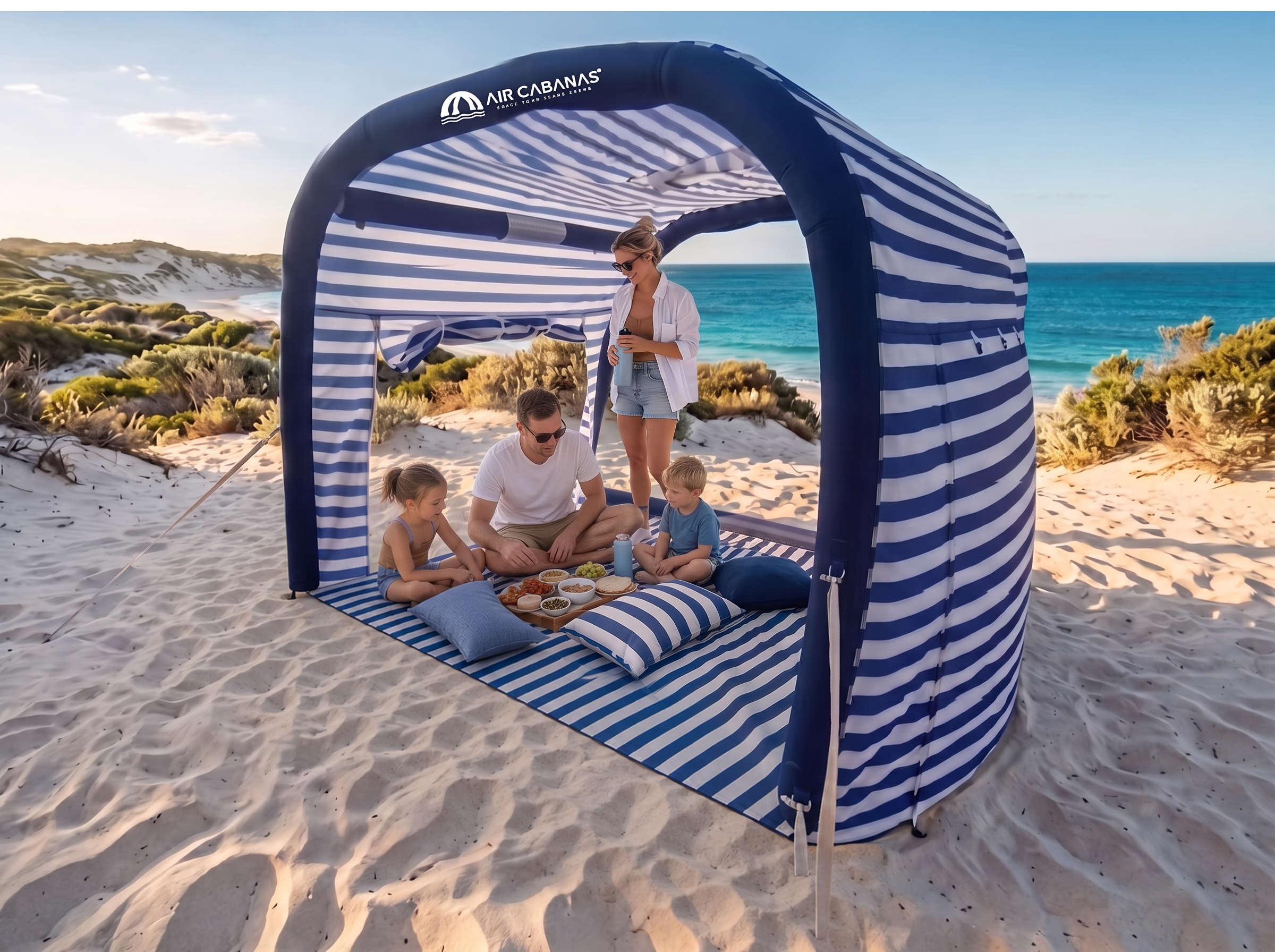
The introduction of modern inflatable design has revolutionised how families approach seaside sun defence. By replacing rigid aluminium supports with high-pressure air tubes, an air cabana provides outstanding stability without dangerous metallic parts. If sudden coastal gusts hit the shelter, the flexible air beams gently yield and immediately snap back into upright form, eliminating the risk of bent poles, crushed hinges, or runaway metal spikes traversing crowded family beaches.
Modern beachgoers searching for a premium cool cabana experience increasingly choose the AirCabana for its seamless blend of safety and setup ease. With no heavy frame components to interlock or carry across long sand dunes, unpacking and inflating the canopy becomes an effortless task completed within minutes. The resulting structure creates an expansive, dependable oasis that keeps everyone protected from intense overhead ultraviolet radiation without the hazards of rigid framework failure.
Safe Anchoring and Shoreline Supervision
Regardless of canopy style, securing your shelter against coastal updrafts demands proper technique and constant vigilance. Heavy-duty sandbags integrated into corner legs should always be filled to capacity with wet sand, providing deep ballast that resists ocean breezes. Digging anchor points beneath dry surface sand ensures the structure stays firmly planted on shifting dunes.
Weather conditions along the coast can deteriorate rapidly with incoming southerly changes or sudden afternoon storms. Beachgoers should maintain close adult supervision of their shade setup throughout the day, inspecting anchor points periodically. If winds strengthen to uncomfortable levels or visual warnings suggest squalls, pack down the canopy immediately to prevent damage and ensure beach safety.
Maximising Diffuse Radiation Protection Under Beach Canopies
One of the most misunderstood elements of beach shade skin cancer prevention involves peripheral radiation reflection. When seated under a shade canopy, direct overhead sun is blocked, yet open sides permit diffuse radiation reflected from the surrounding sand and water to reach the skin. This ambient exposure explains why individuals who stay under low-quality umbrellas all day can still end up with facial burns and shoulder redness by late afternoon.
To counter the effects of diffuse scattering, the physical footprint of your beach shade plays a crucial role. A larger canopy, such as the AirCabana Family, creates a generous shaded zone where occupants can relax well away from sunny perimeters. Positioning towels and gear towards the center of the footprint maximises distance from surrounding reflective sand, drastically reducing the volume of scattered rays striking exposed limbs.
Supplementary physical measures further reduce ambient exposure while relaxing beneath your shelter. Wearing quality polarised sunglasses with a high eye-protection factor shields sensitive corneas from sand glare, while wide-brim hats keep angled rays off noses and necks. Layering reliable shelter geometry with personal UV accessories ensures that both direct and ambient radiation pathways remain fully guarded throughout the day.
Establishing a Skin-Smart Beach Routine for Families
Creating a healthy beach routine begins well before stepping onto the burning sand dunes. Applying broad-spectrum, water-resistant sunscreen twenty minutes prior to outdoor exposure gives protective filters time to bond with the skin surface. Combining this morning routine with UPF 50+ swim shirts for children creates an immediate baseline of protection before anyone dives into the first ocean breaker.
Upon arriving at the beach, setting up your dedicated shade canopy should always represent the first physical action rather than an afterthought. An aircabana allows parents to inflate an expansive shade headquarters swiftly, giving toddlers, infants, and grandparents an instant haven away from scorching sunshine while boards and beach toys are unloaded. This dedicated refuge encourages regular rest breaks between prolonged swims.
Hydration and regular reapplication round out a comprehensive sun-safe outing. Spending hours in ocean spray masks fluid loss, leaving beachgoers vulnerable to heat exhaustion alongside UV exposure. Keeping chilled water bottles beneath your UPF 50+ shelter and applying sunscreen after towel-drying guarantees your family enjoys pristine coastlines with complete peace of mind, preserving skin vitality for years ahead.
Frequently asked questions
Get clear answers to common questions about sun protection, shade setups, and coastal UV risks.
Can you get skin cancer sitting in the shade?
Yes, you can still develop skin cancer from UV exposure received in the shade. While canopies block direct overhead rays, diffuse ultraviolet radiation reflects off ocean water and coastal sand, reaching skin beneath open shelters. High-quality sun management requires pairing dense UPF 50+ canopies with broad-brimmed hats, protective clothing, sunglasses, and regular sunscreen applications throughout your beach stay.
What UPF rating should beach shade have?
Australian sun safety standards recommend choosing a beach shade rated UPF 50+, which represents excellent protection. A UPF 50+ canopy blocks at least ninety-eight percent of direct ultraviolet radiation, allowing only one fiftieth of solar rays to penetrate the fabric weave. Shelters with lower ratings allow excessive harmful UV radiation to filter through onto resting occupants.
Why is the UV index so high at Australian beaches?
Australia experiences extreme UV levels due to elliptical planetary orbits bringing the continent closer to the sun during southern hemisphere summer, coupled with naturally clear atmospheric conditions. At coastal beaches, reflective white sand and water surfaces scatter solar radiation upwards, intensifying exposure compared to inland locations and accelerating skin cell damage.
Are air cabanas safer than traditional pole cabanas?
Air cabanas replace heavy, rigid aluminium and steel framework with high-pressure inflatable air beams. When sudden beach gusts hit the structure, flexible air beams simply flex and rebound rather than snapping, bending, or lifting sharp metal poles into crowded beach areas. They eliminate puncture hazards while maintaining expansive, reliable UPF 50+ family sun shade.