Beach Canopy vs Beach Umbrella: Australian Wind Test
Beach canopy vs beach umbrella: discover why umbrellas fail in coastal winds, how canopies deliver superior stability, and which shelter suits Australian…
Published 2026-11-02T20:01:24.705+00:00
Heading down to the coastline on a sparkling summer morning is an Australian ritual, yet nothing tests your patience faster than fighting with flimsy shade. When selecting the right coastal shelter, deciding between a traditional beach umbrella and a modern beach canopy is the pivotal choice every ocean-loving household faces. With unpredictable coastal winds, baking ultraviolet indexes, and crowded shorelines, understanding how these setups compare in stability, packability, and safety will ensure your seaside days stay relaxed, sun-safe, and thoroughly enjoyable.
Why traditional umbrellas struggle on Australian coastlines
Every Australian beachgoer knows the familiar silhouette of a coastal afternoon: a sudden southerly buster rolls in, towels take flight, and a rogue umbrella turns inside out before cartwheeling across the tide line. Traditional beach umbrellas were originally designed for gentle garden breezes or sheltered Mediterranean coves, not the turbulent onshore gusts typical of Australia’s exposed coastal strips. With a single central pole anchored merely a few inches into loose, shifting sand, an umbrella functions essentially like an unguided parachute waiting for sufficient lift.
The engineering reality of an umbrella works against coastal stability. Because the canopy creates a domed surface above a solitary pivot point, wind passing over the top generates aerodynamic lift while swirling gusts underneath create upward pressure. In beach settings where sand behaves like fluid grains rather than compacted soil, the central spike loses friction almost immediately. Once the pole begins to wobble, the hole widens, the angle tilts, and the entire structure turns into a hazardous projectile that endangers other families enjoying the shoreline.
Beyond the immediate safety risk, standard umbrellas provide remarkably inefficient shade coverage across the heat of the day. The sun arcs continuously across the Southern Hemisphere sky, requiring you to constantly get up, wrench the pole free, re-angle the canopy, and stomp the sand down again. By midday, a standard umbrella leaves half your towel baking in harsh UV radiation, turning what should have been a relaxing coastal escape into an endless battle of readjustment and anxiety whenever the afternoon sea breeze stiffens.
The physics of wind failure in single-pole setups
When coastal gusts hit an open umbrella, the entire load transfers down a thin metal or fibreglass shaft into a single point of ground contact. Without corner counterweights or secondary guy ropes, the torsional strain on the lower joint becomes immense. Sand displacement occurs exponentially faster once small vibrations travel down the pole, loosening the grip of the sand anchor and causing inevitable failure.
What a beach canopy changes for coastal shade
Choosing a beach canopy fundamentally transforms how you interact with coastal conditions. Instead of relying on a precarious central post, a canopy distributes atmospheric forces across multiple ground contact points or engineered perimeter anchor pockets. This structural evolution prevents the canopy from tipping or rolling when coastal breezes pick up, trading the nerve-wracking instability of an umbrella for dependable, grounded composure. Families can finally stretch out without keeping one nervous hand braced against a vibrating pole.
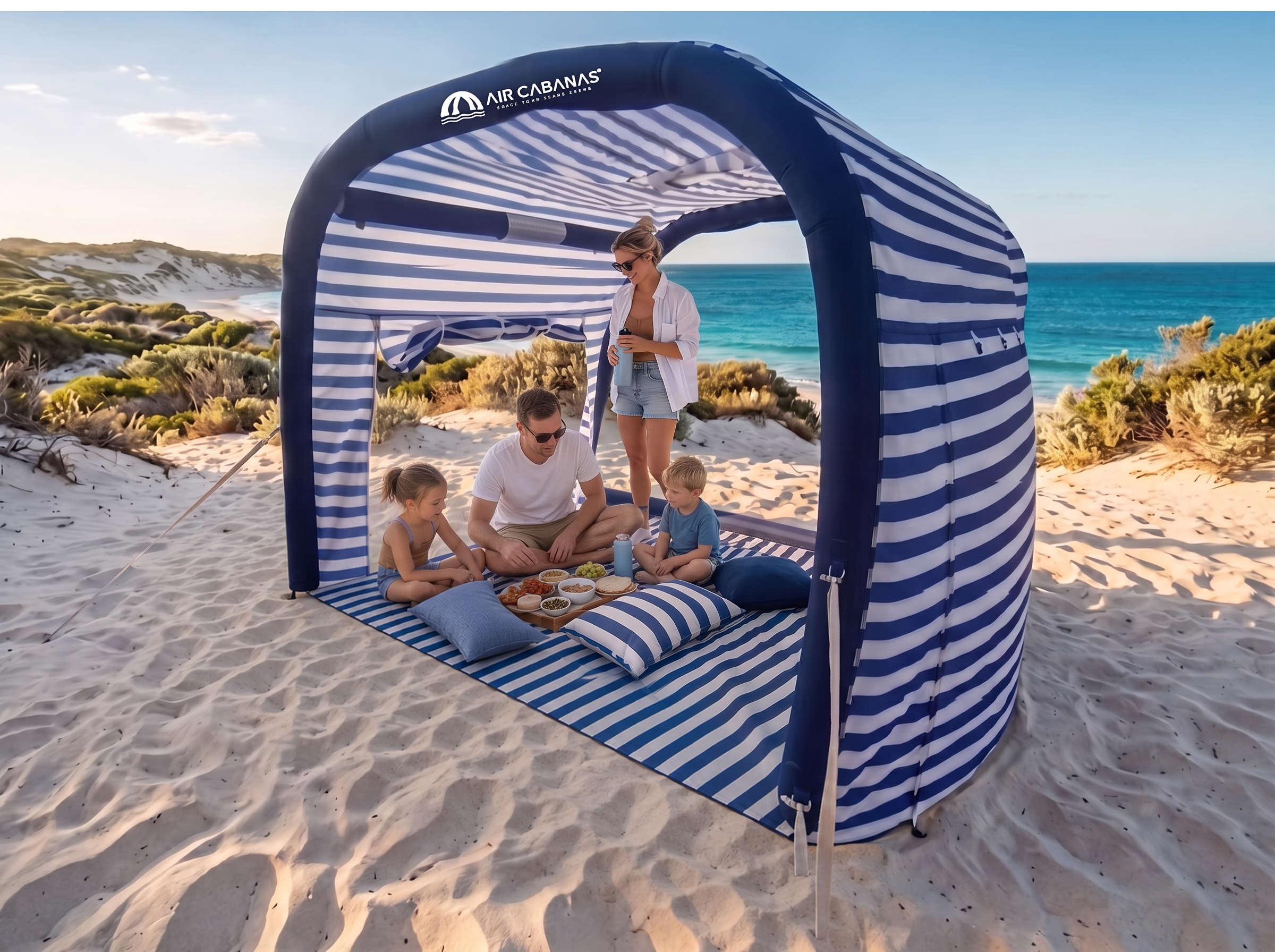
The practical shelter delivered by an engineered beach canopy also vastly outclasses conventional options. By lifting the shaded ceiling across four dedicated corners or inflatable structural beams, you create an open-air living room on the sand. There is ample room for multiple beach chairs, eskies, surfboards, and sleeping toddlers, all while enjoying uninterrupted panoramic views of the breakers. Rather than crowding beneath a cramped, circular dome, your family enjoys legitimate square-metre coverage that stays shielded even as the sun tracks westward.
Airflow dynamics represent another critical advantage. Well-constructed canopies feature strategic wind-relief vents, flexible geometries, or cross-ventilation pathways that allow strong coastal breezes to flow through rather than gathering destructive momentum beneath the fabric. By mitigating dynamic uplift through smart engineering and corner sand-ballasting, a premium canopy works harmoniously with coastal weather patterns instead of fighting against them, delivering tranquil shade across demanding Australian shores.
Comparing stability: central spike vs multi-point anchoring
The key performance difference between these two beach shelters comes down to anchoring physics. Traditional umbrellas rely on friction along a single narrow tube, sometimes assisted by an auger screw thread. Unfortunately, dry beach sand lacks cohesion; under cyclic lateral loading from gusts, the surrounding grains liquefy and yield. In contrast, modern beach shelters employ perimeter ballast pockets that can each hold 10 to 15 kilograms of damp sand, generating a grounded mass that naturally pins the structure to the foreshore.
For decades, the standard alternative to the unstable umbrella was the heavy pole-frame cabanas category. While those four-corner frames solved the single-pole problem by introducing perimeter sand pockets, they brought a new set of compromises: rigid steel or aluminium poles that rattle in gusts, pinch fingers during setup, and bend permanently if a sudden gust catches an unweighted leg. The weight of carrying bundles of metal poles across hot dunes also turned setup into a sweaty chore before your beach day even started.
This is where modern air-tube engineering elevates the entire concept. The AirCabana reimagines coastal stability by swapping rigid, bendable metal frameworks for high-pressure inflatable air beams. When secured with sand pockets and corner pegs, an air cabana absorbs buffeting coastal winds with built-in flex, bending gently under severe pressure without snapping or warping before springing straight back into shape. This eliminates rigid pinch hazards entirely, offering families an ultra-stable cool cabana experience without the clunky metal hardware.
Pack-down size, carry weight, and everyday usability
A beach shelter is only as good as your willingness to haul it from the car park across scorching dunes to the water’s edge. Standard umbrellas are relatively light, yet their awkward length frequently bangs against your knees or fails to fit sideways into compact car boots. On the other hand, traditional pole-frame cabanas require lengthy, heavy carry bags packed with metal components, guy lines, and ground spikes that quickly become a burden when juggling toddlers, boogie boards, and picnic bags.
Modern inflatable alternatives have rewritten expectations for portable coastal gear. Because the AirCabana relies on air-beam architecture rather than solid struts, the entire shelter packs down into a streamlined, compact shoulder bag that easily slides into any boot alongside your weekend luggage. Pumping up the structure takes only minutes with a dedicated high-capacity pump, allowing a single parent to manage the entire setup effortlessly while keeping a watchful eye on children playing near the shoreline.
Pack-down speed proves equally crucial, particularly when coastal weather deteriorates rapidly. Wrestling with jammed button locks on sun-baked aluminium poles while wind-whipped sand stings your legs is an ordeal every beachgoer dreads. In contrast, deflating an air-supported shelter requires simply releasing the rapid-dump valve; the canopy collapses smoothly in seconds, ready to be rolled up and slipped into its bag without stubborn metal parts binding with gritty sand grains.
UV protection and usable shade footprint compared
Under the harsh Australian sun, the quality and footprint of your shade are matters of genuine daytime comfort. A modest umbrella spanning 1.5 to 1.8 metres creates a relatively small puddle of shade. Because UV rays reflect strongly off white silica sand and sea foam, sitting at the periphery of an umbrella often leaves your skin exposed to intense indirect radiation, even if your head feels sheltered from direct overhead rays.
A dedicated beach canopy significantly expands your protective perimeter, offering expansive footprints ranging from 4 to over 6 square metres of dedicated UPF50+ fabric. This substantial overhead barrier blocks the vast majority of direct ultraviolet radiation while reducing ambient heat build-up beneath the canopy. With broad square coverage, children can play happily in the cool sand directly under the shelter without parents needing to constantly shuffle gear to follow retreating shadows.
When comparing long-term fabric performance, cheap umbrella textiles tend to degrade quickly, thinning out under persistent sun exposure and fraying along stressed seams. High-grade canopies utilise heavily treated, tightly woven ripstop textiles built to withstand prolonged salt-air exposure and harsh solar conditions. Investing in a resilient shelter guarantees dependable, sun-safe performance season after season on Australia’s premier coastlines.
Safety considerations for unpredictable Australian beach weather
Australian coastal weather can change in a matter of moments. An idyllic, glassy morning at the beach can rapidly transform when a stiff thermal wind or sudden squall sweeps across the headland. Irresponsible beach shelter usage presents a major hazard across crowded shorelines, with flying umbrella spikes responsible for numerous beach injuries each summer. Choosing a shelter with secure corner ballast is the first step toward responsible foreshore safety.
Even with the most stable canopy or AirCabana setup, proper anchoring protocol remains essential. Always orient the shelter so wind flows smoothly across its aerodynamic profile, and pack sand pockets completely full using damp, compacted sand scooped from below the dry surface layer. Never leave an erected shelter unattended for extended periods, and always maintain clear sightlines to ocean conditions so you can act before extreme weather hits.
No beach shade is indestructible or entirely wind-proof, and responsible ocean users should always exercise sound safety judgement. If local surf lifesavers raise warning flags, or if conditions become so blustery that sand whips across the beach and walking becomes difficult, the safest and smartest decision is always to pack down your shelter immediately. Prioritising personal and community safety ensures that your beach adventures remain memorable for the right reasons.
Frequently asked questions
Got questions about choosing the right coastal shade? Here are clear, straightforward answers to the most common queries Australians search when planning their beach setups.
Is a beach canopy better than an umbrella in coastal wind?
Yes, a beach canopy is substantially better in coastal wind. Unlike umbrellas that pivot on a single central post, canopies distribute wind pressure across multiple reinforced anchor points and weighted sand pockets. This multi-point anchoring prevents the shelter from catching air like a parachute, delivering reliable stability on breezy open beaches.
How much wind can a beach canopy handle safely?
A properly anchored canopy can comfortably manage typical fresh coastal breezes when weighted with damp sand. However, no beach shade should be treated as storm-proof. If gusts begin whipping sand through the air or lifesavers lower safety flags, you should immediately pack down your shelter to avoid damage and protect others.
Are air cabanas easy for one person to set up alone?
Yes, an air cabana is designed for effortless solo setup. You simply roll out the fabric base, fill the corner sand pockets to secure the footprint, attach the pump, and inflate the structural beams in under two minutes. There are no heavy metal poles to balance, connect, or force into stubborn sand.
Can an umbrella cause damage or injury on a crowded beach?
Yes, loose beach umbrellas cause serious injuries every year across Australian beaches. When an umbrella lifts in a sudden gust, its sharp central pole turns into a high-speed projectile across crowded sand. Multi-anchored canopies with weighted corners or air beams eliminate this hazard entirely.
How do you keep a beach canopy anchored in loose sand?
To anchor securely in loose sand, dig down a few centimetres to reach damp, heavy sand to fill your corner ballast pockets completely. Ensure each corner pocket is packed full and angled outward from the shelter to maintain continuous tension across the canopy structure throughout the day.