Beach Cabana Size Guide: How Much Shade Do You Need?
Confused about beach cabana size? Compare 2.0m medium vs 2.4m large shelters with real family scenarios to choose the perfect coastal shade for your…
Published 2026-10-24T20:00:50.52+00:00
Finding the right beach cabana size can make the difference between an effortless, breezy day on the Australian coast and an exhausting battle for every sliver of shade. With harsh UV levels defining our summers, reliable overhead shelter is non-negotiable. But between compact models designed for couples and sprawling family canopies, working out exactly how much shade you require on the sand takes some thought. In this guide, we break down canopy dimensions, sun angles, and real-world family setups to help you select your ideal beach cabana size.
Understanding Beach Cabana Size and Usable Shade
When you walk across the sand at Bondi, Cottesloe, or Burleigh Heads on a blistering January morning, the landscape is dotted with sun shelters of every possible dimension. Yet looking across the shoreline, you will quickly notice a common struggle: beachgoers constantly dragging their towels, shifting their esky, and angling their gear to escape a scorching sunbeam. Choosing the correct beach cabana size is not merely about finding a shelter that physically fits into your car boot; it is fundamentally about understanding how solar angles dictate usable ground shade throughout the day.
In Australia, the harsh southern sun rarely sits dead-centre overhead for more than a brief window around solar noon. For the rest of your session, the ultraviolet rays beam in at an acute angle, projecting the canopy’s shadow several metres away from the physical footprint of the shelter. A canopy that appears generous on paper can suddenly leave your legs bake-browning on the sand if you do not factor in how the sun tracks across the sky. Calculating your beach cabana size requires balancing the geometric footprint of the frame against this constantly moving cast of shade.
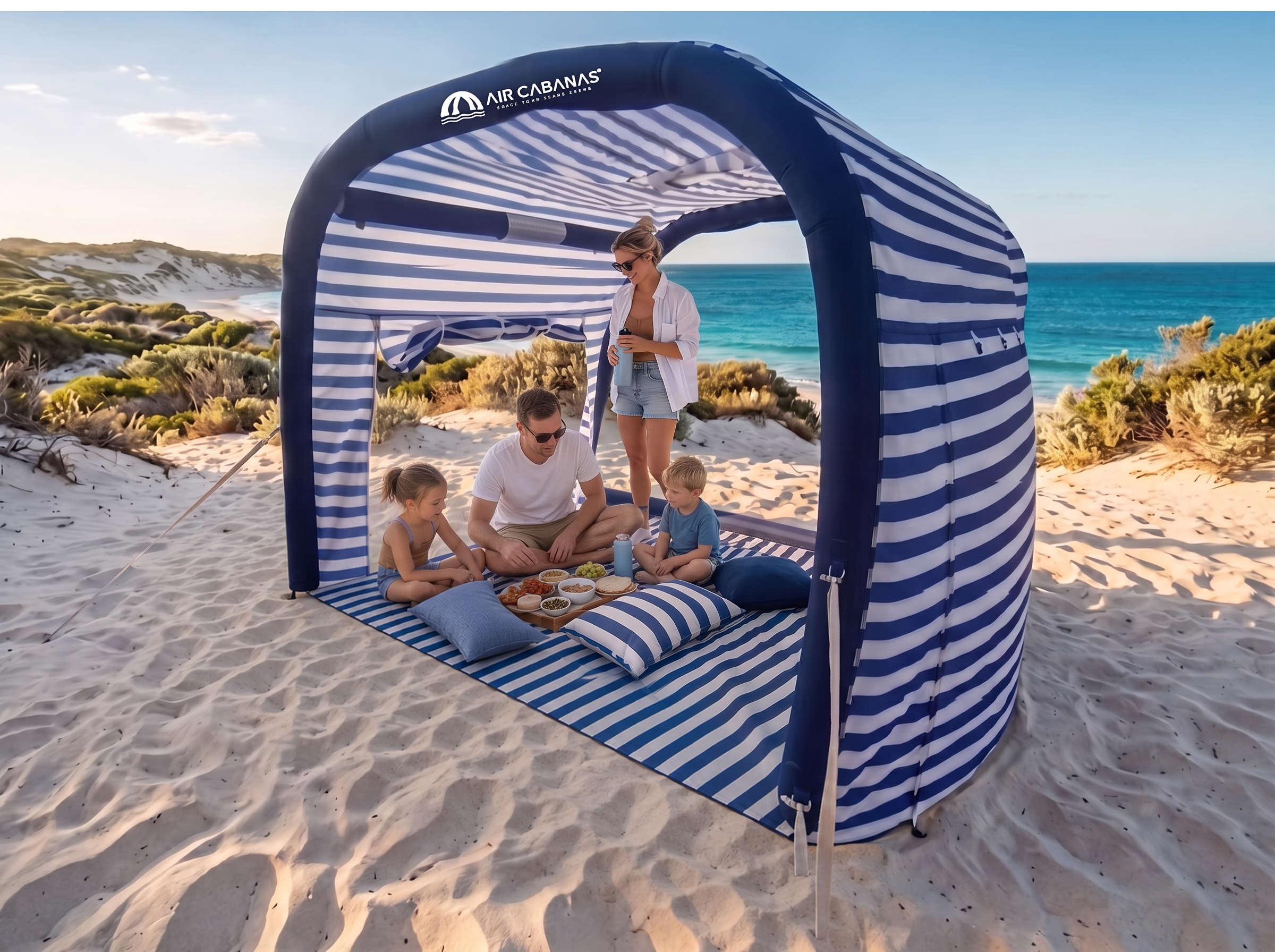
Furthermore, you have to account for dead space versus usable living space. Traditional pole-frame cabanas require a thick central mast embedded deep into the sand, which immediately bisects your floor plan and limits where people can recline. In contrast, modern inflatable alternatives like the AirCabana rely on arching air-beam architecture that keeps the interior completely open. Regardless of the frame style you select, evaluating your real-world spatial requirements before you purchase saves you from frustrating mornings spent shuffling camp chairs along the perimeter.
The Real Comparison: 2.0m Medium vs 2.4m Large
When evaluating options on the Australian market, the core decision almost always comes down to 2.0m Medium vs 2.4m Large. At first glance, forty centimetres might seem like a negligible variance—hardly worth agonizing over when packing the family wagon. However, in two-dimensional square metre coverage, that incremental 40-centimetre expansion represents a massive leap in ground real estate, growing your overhead shelter from 4.0 square metres to roughly 5.76 square metres of dedicated sun protection.
A 2.0m Medium cabana is generally engineered as an agile, everyday shelter. It is lightweight, rapid to hoist or pump up, and leaves a tidy footprint on crowded urban beaches where sand space is at a premium during peak holiday periods. For solo beach lovers, couples, or a parent with a toddler, a 2.0m footprint creates a cosy, sheltered haven that effortlessly shields two low-line beach chairs and a compact day pack from the blazing midday heat.
On the flip side, the 2.4m Large shelter is the undisputed powerhouse of coastal family living. That additional 1.76 square metres of fabric transforms the shelter from a quiet rest nook into a functional basecamp. Under a 2.4m canopy, you can comfortably station full-sized reclining loungers, a substantial family cooler, multiple dry bags, and still retain enough central ground clearance for kids to play out of the direct glare. When weighing up 2.0m Medium vs 2.4m Large, remember that extra surface area provides a far wider shadow cast during early morning and late afternoon sessions.
Matching Your Beach Cabana Size to Real Family Scenarios
To choose the perfect shelter, it helps to visualise your typical weekend coastal ritual. Let us walk through how different setups behave on the sand, starting with the young couple or two mates hitting the surf at dawn. In this scenario, gear is generally minimal: two towels, a pair of water bottles, a small dry bag, and perhaps a small soft cooler. A 2.0m medium beach cabana size provides plenty of overhead shielding, effortlessly covering two reclining adults without monopolising unnecessary sand or demanding excess setup effort.
Consider the young family scenario: two parents accompanied by a toddler and an infant. The inventory multiplies exponentially to include a bulky nappy bag, a portable travel cot or baby dome, a bumper esky packed with cut fruit and cold drinks, swim toys, and multiple changes of clothes. Here, a 2.0m shelter will quickly feel claustrophobic, forcing parents to push gear out into the blazing sun just to make room for a feeding session or a baby nap. Upgrading to a 2.4m canopy provides the essential breathing room required to keep little ones securely shaded, safe, and happy.
Finally, imagine the extended weekend crew: three or four adults spending a full six-hour Saturday by the waves, joined by older kids running back and forth from the surf. For this lifestyle, nothing short of a 2.4m large cabana will suffice. It allows adults to sit comfortably in high-backed folding chairs while the younger crew drops their wet boards and rashies around the perimeter. Ensuring everyone stays protected under a cool cabana setup means no one gets nudged out into the harsh Australian sun.
Angle of the Sun: Why Your Beach Cabana Size Matters Throughout the Day
One of the most common oversights beachgoers make when calculating their beach cabana size is assuming the sun will remain directly overhead. In reality, Australian coastal sun moves across an arc that drastically warps your shadow zone. At 9:00 AM, when families typically arrive at the inlet or ocean beach, the sun is low on the eastern horizon. The actual shade generated by your canopy does not sit beneath the fabric roof; it is cast three to four metres to the west, well outside your carefully planned boundary.
As solar noon approaches, the shadow contracts inward, aligning tightly under the roofline. Then, as the afternoon easterly sea breeze picks up and the sun dips into the west, that shadow stretches out towards the ocean. If your canopy is undersized, you will spend the entire afternoon nudging your towels and chairs further out into the open sand just to chase the patch of shade, leaving your personal belongings exposed to ambient heat and sand spray.
This dynamic shadow play is precisely why choosing an expansive beach cabana size delivers peace of mind. A broader 2.4m square overhead canopy casts a considerably larger, deeper shadow swath across every hour of the day. This wider footprint ensures that even when the sun descends and angles inwards, a generous, continuous pocket of usable shade remains safely anchored within your personal camp.
Pack-Down Size, Boot Space, and Portability Considerations
While maximum shade is always the dream on the sand, you still have to transport your shelter from your home garage to the water's edge. This is where physical dimensions, folded length, and carrying weight must be factored into your buying decision. Traditional pole-frame cabanas often feature rigid centre aluminium poles that measure between 1.2 and 1.5 metres long when folded into their carry bags. Trying to wedge an awkward, rigid 1.4-metre steel or aluminium bag horizontally across a compact hatchback boot can quickly become an exercise in frustration.
This packing friction is one of the distinct advantages of inflatable engineering. The AirCabana completely replaces rigid metal struts and extendable central shafts with heavy-duty, puncture-resistant TPU air beams. Because these structural arches deflate entirely at the turn of a valve, even a large family-sized AirCabana folds down into a neat, compact duffle bag that slips effortlessly into the smallest car boot alongside prams, boogie boards, and grocery bags.
Weight is another crucial element to evaluate, especially if your favourite beach entails a trek across soft dunes, timber boardwalks, or steep staircases like those found along the coastal tracks of Victoria or Western Australia. A shelter that is lightweight and easy to carry over your shoulder ensures you actually take it with you on quick morning dips, rather than leaving it behind in the garage because it is simply too cumbersome to haul.
Wind Stability and Setup: How Size Influences Anchoring Safety
When selecting your beach cabana size, it is vital to respect the immense power of Australian coastal winds. An increase in canopy surface area brings a corresponding increase in wind resistance. A 2.4m canopy acts as a larger sail than a 2.0m canopy, meaning proper anchoring technique and vigilant beach awareness become even more essential to ensure everyone on the shoreline remains safe.
Regardless of whether you choose a 2.0m or 2.4m footprint, sand pocket ballast is the gold standard for securing coastal shelters. Always ensure every corner sand pocket is filled to maximum capacity with wet, heavy sand dug from beneath the dry surface layer. Never leave a shade shelter unattended in gusty coastal conditions. If the sea breeze turns into a howling gale or an unpredictable squall rolls in over the horizon, make the proactive safety call to drop the canopy, deflate the beams, and pack down your gear.
Structural design plays a massive role in how different sizes handle coastal gusts. Traditional rigid pole-frame cabanas rely on mechanical hinges, metal cross-arms, and central lock pins that can bend, snap, or buckle under violent, erratic wind loads. By contrast, an inflatable air-tube shelter like the AirCabana features flexible structural beams that absorb sudden wind gusts by flexing naturally and popping straight back into shape, eliminating rigid metal failure points while maintaining dependable coastal shade.
Frequently asked questions
Here are straightforward answers to the most common questions Australians ask when choosing their beach shade shelter size.
What beach cabana size is best for a family of four?
For a family of four, a 2.4m large beach cabana size is by far the best option. It provides roughly 5.76 square metres of shade, which comfortably accommodates two adult beach chairs, kids sitting on towels, a large esky, and day bags without anyone getting pushed out into the sun.
Can one person set up a large beach cabana alone?
Yes, modern shelters are designed for solo setup. Inflatable models like the AirCabana take under two minutes with a high-capacity hand pump, while pole models can be erected alone if you fill the sand pockets immediately to stop the frame catching the breeze during assembly.
Is a 2.0m cabana big enough for beach chairs?
A 2.0m cabana easily accommodates two low-profile beach chairs side by side, along with a small cooler and personal tote bags. However, high-backed camp chairs with long leg extensions will push your feet outside the shaded footprint during early morning or late afternoon sun.
How does beach cabana size affect wind resistance?
Larger canopies catch more wind due to increased surface area. A 2.4m cabana requires more ballast weight in its sand pockets than a 2.0m model. Always pack sand pockets completely full with dense, damp sand, and pack your shelter away if squalls or unsafe winds develop.