Beach Awning vs Car Awning: Coastal Camping Guide
Debating a beach awning versus a 4WD car awning for coastal camping? Compare sand stability, pack weight, and wind safety to pick the right beach setup.
Published 2026-10-26T20:00:33.685+00:00
Setting out on an Australian coastal camping adventure means preparing for long sun-drenched days, sweeping ocean breezes, and relentless summer UV. One of the biggest gear decisions touring campers face is whether to mount a 4WD pull-out shade or pack a dedicated portable beach awning for daily sun protection. While vehicle awnings have long been a fixture of off-road touring, seaside conditions demand unique flexibility. From parking restrictions on fragile dunes to deep tidal sand, choosing the right shelter format determines whether you spend your beach days relaxing under cool shade or battling unwieldy gear.
Choosing Between a Beach Awning and a 4WD Car Awning
Planning a coastal camping escape along the Australian shoreline usually comes down to one critical priority: reliable sun protection. When you are spending dawn until dusk exposed to reflective white sands and high UV levels, having an effective shelter makes or breaks your trip. Campers often debate whether a fixed 4WD vehicle setup or an independent beach awning represents the smarter investment for seaside touring across Australia. Both styles offer distinct advantages, but their real-world utility depends on how close your vehicle can actually get to the water.
A 4WD rooftop shelter is an Australian touring staple, bolted securely to roof racks and ready to pull out in moments over a dusty track. However, coastal environments present unique challenges that quickly highlight the structural differences between these two concepts. National park regulations, steep foredunes, soft tidal zones, and pedestrian-only conservation strips frequently separate your vehicle track from the actual shoreline by dozens or hundreds of metres. In those scenarios, a shelter bolted to your roof rack remains stranded in the car park while your family swelters on the sand.
Understanding the operational boundaries of both designs ensures you pack the right setup for your travel style. While vehicle-mounted pull-outs excel for roadside lunch stops and inland bush touring, dedicated coastal camping demands shelter solutions built specifically to handle loose coastal sand, tidal shifts, and sweeping coastal breezes. Examining the core mechanics of each setup reveals why a freestanding shelter often provides superior flexibility when salt, swell, and soft sand enter the equation.
The Realities of Coastal Sand and Vehicle Access
Australia is blessed with world-renowned drive-on beaches, from Fraser Island (K'gari) and Teewah Beach in Queensland to South Australia's Limestone Coast and Western Australia's Esperance tracks. Even on these permissible beaches, parking directly where you want to spend the day is not always feasible. High tide lines, soft drift sand, and dune conservation fencing frequently dictate that vehicles stay parked well above the high-water mark, often back against the foredune where the breeze is blocked and temperatures soar.
Setting up your day right by the water’s edge allows you to keep a watchful eye on swimming children, enjoy refreshing onshore sea breezes, and avoid long walks across scorching sand just to reach your esky. A vehicle awning confines your entire day to the footprint of your 4WD, whereas a portable shelter lets you claim prime real estate right where the coastal action is happening.
Portability and Versatility Away From the Vehicle
The defining advantage of a dedicated beach shade shelter is portability and versatility away from the vehicle. When coastal tracks end at a timber boardwalk or a steep sandy walking trail, a rooftop shelter becomes entirely redundant for day use. Having a lightweight shelter packed into a compact over-the-shoulder carry bag means you can effortlessly walk over dunes, hike down secluded coastal headlands, or stroll down to sheltered tidal lagoons that no four-wheel drive could ever reach.
This mobility transforms how you spend your coastal holidays. Rather than being tied to wherever you can safely park without getting bogged in soft sand, you gain total freedom of movement across any coastal landscape. A modern beach awning can be slung over your shoulder alongside your towel and beach tote, allowing a single person to walk hundreds of metres effortlessly without hauling heavy aluminium extrusions, bulky metal poles, or cumbersome hardware across loose dunes.
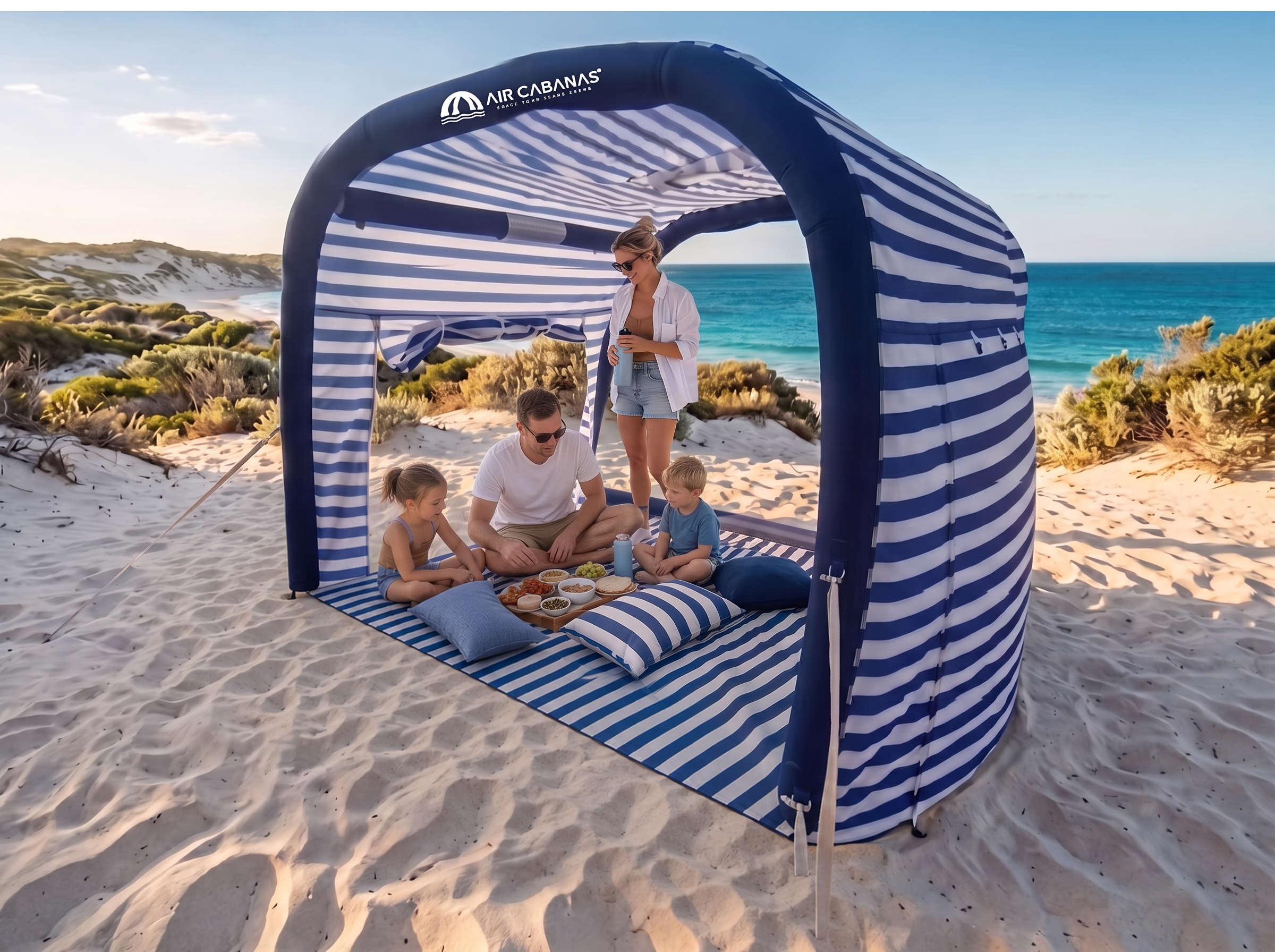
Furthermore, modern inflatable designs like AirCabana have redefined how easy beach transit can be. By replacing rigid metal frameworks with durable, puncture-resistant air beams, an AirCabana delivers a generous footprint of UPF 50+ coastal shade while packing down into a tidy, manageable tote. Whether you are navigating the rocky steps of an isolated New South Wales cove or walking down a busy Victorian surf beach, carrying your shelter by hand gives you access to the best patches of sand without vehicular limitations.
Set-up Time, Ease, and Solo Beach Pitching
Coastal camping requires shelter that can be pitched swiftly and safely without requiring multiple pairs of hands to hold uprights against a gusting sea breeze. Pulling out an expansive 270-degree vehicle awning on a breezy beach track can turn into a wrestling match, as large fabric sails catch the wind before support arms and ratchet straps can be pinned into soft, uncooperative terrain. If you are handling camp duties solo or looking after excited kids, wrestling with complex mechanical arms adds unnecessary stress.
Freestanding shelters vary considerably in their assembly mechanics. Traditional pole-frame cabanas rely on interconnected metal or fibreglass ribs, a central mast, and perimeter sand pockets. While these pole-frame cabanas are widely recognised as a common cool cabana style across Australian coastlines, assembling metal joints under tension on a windy beach can feel awkward and poses pinching hazards when gusty conditions shake the half-assembled frame. Dropping loose pins or struggling with rigid spreader bars in powdery sand often complicates an otherwise simple morning.
By contrast, an inflatable beach awning eliminates rigid poles altogether. With AirCabana, you simply lay the canopy flat, add an initial shovel of sand into the corner anchor pockets to secure your position, and use the rapid dual-action hand pump to inflate the structural air beams in under a minute. The shelter rises smoothly into shape without rigid components that can snap, twist, or whip around in sea gusts. A single person can achieve a stable, taut pitch in minutes, leaving plenty of daylight to enjoy the surf.
Managing Coastal Winds and Structural Safety
Wind is a constant companion along the Australian coastline, turning gentle morning sessions into vigorous afternoon blowouts as thermal sea breezes build across the water. Any beach shelter—whether bolted to a heavy steel bullbar rack or anchored on the open sand—acts as a substantial aerodynamic sail. How a shelter responds to sudden wind gusts is a fundamental safety consideration for every coastal camper and beachgoer.
Vehicle-mounted awnings feature long, rigid aluminium rafter arms that create immense mechanical leverage against your vehicle’s roof racks. If a sudden coastal squall catches underneath an extended horizontal car awning, the upward force can easily bend aluminium knuckles, snap hinge brackets, or twist vehicle mountings. Even worse, if ground pegs pull out of loose sand, an unmoored metal-framed awning can pivot violently, causing thousands of dollars in vehicle bodywork damage or presenting a severe impact risk to anyone standing nearby.
A dedicated coastal beach awning addresses wind through flexible design and deep sand ballast rather than rigid leverage. Modern inflatable air-tube cabanas provide exceptional shock absorption; instead of snapping or bending under load, flexible air beams absorb gust energy and simply rebound to their original shape once the gust subsides. Because there are no rigid metal poles or sharp hinges under tension, the risk of structural failure causing personal injury is substantially reduced. Nevertheless, beachgoers must always ensure sand pockets are buried completely and pack down their shelter promptly whenever adverse squalls or unsafe wind conditions develop.
Everyday Practicality: Camp Base Versus Beach Base
One of the most frustrating aspects of relying exclusively on a vehicle awning during a multi-day coastal camping trip is the loss of vehicle mobility. Once your 4WD awning is deployed, pegged down, and surrounded by camp tables, cooking burners, and camp chairs, your vehicle is effectively immobilised. If you need to drive into the local coastal town for ice, pick up fresh bait, or check a surf break two bays over, you must dismantle your entire shelter setup and pack everything away before turning the key.
Utilising a portable beach awning separates your day-use shade from your touring transport. You can leave your vehicle free to explore remote tracks, launch a boat, or make supply runs while your coastal shade base remains established down on the sand. This distinction becomes especially valuable during extended family holidays, where some family members wish to linger by the water reading a book under UPF 50+ shade while others drive into town or explore 4WD beach tracks nearby.
Durability in harsh maritime environments is another critical factor. Vehicle awnings remain permanently mounted on roof racks, continually exposed to highway grime, salt spray, road grit, and blistering Australian sun. Over months of coastal touring, road grime accumulates in the protective travel bags, zippers seize from salt crusting, and mould can form in damp rolled fabric. A high-quality portable beach shelter packs away cleanly inside your vehicle boot or camper trailer, rinsed easily with fresh water after use to preserve its fabric coatings and seam tapes for seasons to come.
Why Inflatable Air-Beam Cabanas Redefine Coastal Shade
For decades, Australian beachgoers accepted the compromises of conventional shade structures. You either made do with a floppy beach umbrella that risked inverting and taking flight at the first gust of wind, wrestled with heavy metal-poled gazebos that required multiple people to carry and erect, or used generic pole-frame cabanas that required threading metal uprights into shifting sand. The introduction of engineered air-tube technology has transformed coastal shade into a hassle-free, high-performance experience.
AirCabana engineered this evolution by replacing brittle hardware with tough, pressurised TPU air chambers wrapped in durable protective sleeves. This pneumatic architecture provides robust structural tension across the UPF 50+ canopy without a single metal pole overhead. The absence of heavy aluminium poles drastically reduces packed weight, meaning a spacious family-sized shelter can be effortlessly carried down steep sand tracks, over dunes, or across sprawling tidal flats by one person.
Safety around children is where this modern air-beam construction truly excels. Coastal camping is all about relaxed family living, but energetic kids playing beach cricket or running between towels can easily collide with low-slung guy ropes or rigid metal cabana uprights. With an AirCabana, colliding with an upright air beam results in a gentle bounce rather than a painful bruise or a collapsed metal framework. Combined with integrated, oversized corner sand ballast pockets, inflatable cabanas offer the ultimate blend of lightweight convenience, structural integrity, and family-friendly beach safety.
Frequently asked questions
Here are straight answers to the most common questions Australians ask when comparing beach awnings to car awnings for coastal touring.
Can you use a car awning on the beach?
Yes, you can use a car awning on the beach, provided you have direct 4WD access to firm sand above the high tide mark. However, standard vehicle tent pegs will pull straight out of soft coastal sand; you must secure guy ropes using heavy-duty sand pegs or buried sandbags to prevent wind damage.
What is the best beach awning for coastal winds?
The best beach awning for coastal winds is one that combines deep sand ballast with flexible framework rather than rigid metal poles. Inflatable air-beam shelters like AirCabana flex and absorb sudden wind gusts without bending metal joints or snapping poles, provided sand pockets are filled completely and shelters are packed down during severe conditions.
Is a portable beach awning better than a 4WD awning?
A portable beach awning is often better for coastal trips because it provides shade anywhere along the water, completely independent of your vehicle. It allows you to set up on walking-only beaches, preserves vehicle mobility for supply runs, and eliminates the risk of heavy metal frame damage to your vehicle.
How do you secure a beach awning in soft sand?
To secure a beach awning in soft sand, fill all integrated corner ballast pockets completely with damp, heavy sand from below the dry surface layer. Angle guy ropes outward using dedicated wide-fluke sand pegs or buried deadman anchors, and never leave an unweighted shade structure unattended on an open beach.
Can one person set up an inflatable beach awning?
Yes, an inflatable beach awning is specifically designed for quick, effortless solo setup. You simply spread the fabric, anchor the windward sand pockets, and connect the high-capacity hand pump. The structural air beams inflate in under sixty seconds, providing a taut, stable shelter without needing anyone to hold support poles.