
Air Tube Engineering: How Cabanas Handle Wind
Discover how air tube engineering, internal pressure, flex and load spreading keep an AirCabana standing strong against blustery Australian coastal breezes.
Published 2026-10-27T20:01:02.989+00:00
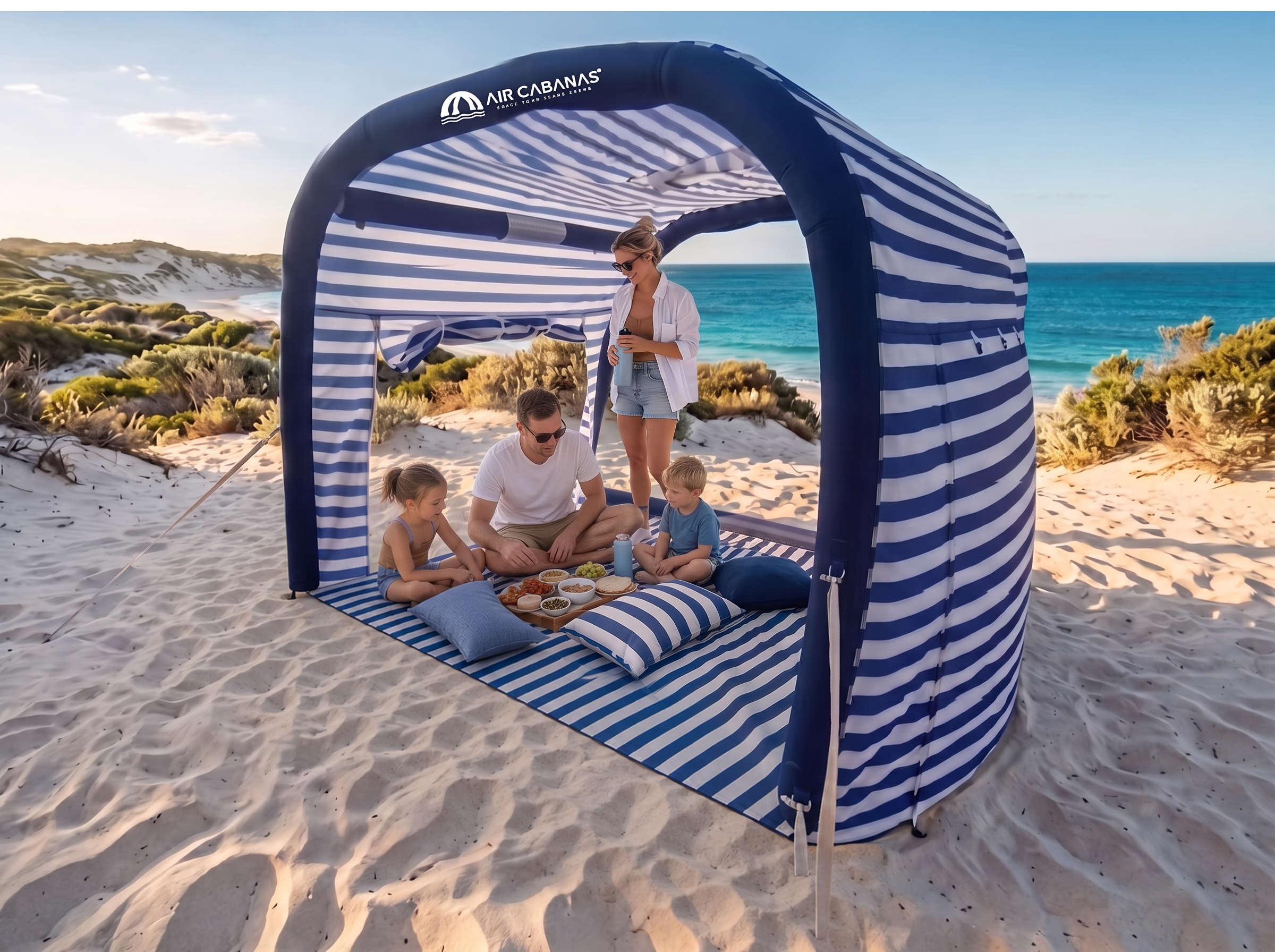
Every Australian who has spent an afternoon along our coastline knows the sudden arrival of the afternoon sea breeze. One minute the ocean is glassy; the next, a stiff onshore gust sweeps across the dunes, testing every umbrella and sun shelter in sight. While standard sunshades often fold, buckle, or cartwheel down the beach, shelters built with modern air tube engineering take an entirely different structural approach. By balancing internal pressure, dynamic flex and load spreading, pressurised pneumatic beams absorb unpredictable wind energy and maintain their shape, ensuring a safer, cooler coastal haven on Australia’s favourite beaches.
The Physics of Air Tube Engineering on Coastal Sands
When you set foot on an exposed coastline like Cronulla, Burleigh Heads or Cottesloe, the first element you encounter is the persistent maritime breeze. Traditional coastal shade has historically relied on rigid timber, aluminium, or fibreglass poles to hold canopies upright against these gusts. However, air tube engineering presents a completely different mechanical response to turbulent coastal winds by substituting rigid structural members with pressurised pneumatic beams.
Rather than fighting wind through sheer physical rigidity, air tube engineering leverages pneumatic mechanics where captive internal air reacts dynamically to ambient air pressure changes. When a sudden gust hits the exterior skin of an inflatable shade, the contained volume compresses momentarily, storing mechanical energy and distributing the atmospheric force across the entire cylindrical chamber rather than focusing stress onto a vulnerable mechanical joint.
In the Australian beach environment, this mechanical difference changes how shade performs throughout a scorching summer afternoon. While rigid structures remain static until their mechanical joints buckle or snap, an air-filled chamber works in harmony with aerodynamic principles. AirCabana harnesses this pneumatic behaviour to deliver reliable coastal shelter, providing shade that absorbs blustery sea breezes through controlled internal pressure dynamics rather than unyielding metal skeletons.
Understanding Internal Pressure and Structural Rigidity
To understand why an inflatable cabana does not collapse under a sudden sea breeze, one must examine internal working pressure. The structural strength of a pneumatic beam relies on the pressure differential between the atmosphere inside the sealed chamber and the external environment. When an air beam is pumped to its recommended working pressure, the tension generated across the textile outer sleeve creates remarkable structural rigidity that mimics a solid beam under regular conditions.
This internal pressure acts as an omnidirectional support system. Unlike an aluminium tube that possesses high compressive strength along its length but vulnerable bending thresholds across its diameter, a pressurised air cylinder pushes outward equally in every direction. When coastal winds blow against the canopy, the internal air redistributes along the chamber, maintaining the cylindrical cross-section and preventing the structural deflation or buckling that many people mistakenly expect from an inflatable shade.
Achieving this reliable equilibrium requires precision engineering within the bladder and the containment sleeve. If internal pressure drops too low, the structure loses its dynamic stiffness and droops under minor breezes. Conversely, optimal pressure ensures that the air beam maintains its upright geometry while retaining sufficient elasticity to absorb gusts. Through dedicated air tube engineering, modern shelters like the AirCabana maintain this crucial pressure profile across long, sun-drenched days on Australian beaches without constant manual reinflation.
Controlled Flex Versus Brittle Failure in Beach Shelters
Anyone who has spent summer afternoons on Victorian surf beaches or windy Western Australian shores has witnessed the dramatic failure modes of traditional shade structures. Conventional pole-frame cabanas rely on thin metal tubes connected by plastic hinges, central hubs, and steel pins. Under heavy, turbulent gusts, these rigid components cannot yield. When wind force exceeds the structural threshold of the alloy or plastic, the result is catastrophic, brittle failure—snapped ribs, bent poles, or torn fabric corners.
Controlled flex represents the core advantage of pneumatic design. Instead of resisting dynamic loads with unbending resistance, air tube engineering allows the frame to flex smoothly when struck by aggressive sea breezes. As a gust drives into the canopy, the pressurised beams deflect slightly, shedding wind resistance by temporarily altering their aerodynamic profile. The moment the gust subsides, the internal pressure immediately returns the beam to its original upright form.
This resilience completely eliminates the risk of snapping metal or shattered composite rods that can turn a relaxing family beach day into a hazardous scramble. A flexible air beam cannot snap in half, fracture, or produce sharp jagged edges. In the context of creating a cool cabana environment where young children, pets, and beach towels share tight quarters, the gentle forgiving nature of pressurised air beams provides immense peace of mind compared to rigid, spring-loaded hardware.
How Load Spreading Eliminates Destructive Stress Concentrations
Mechanical engineers frequently assess structures by identifying stress concentrations—specific points where mechanical force concentrates, accelerating wear and fatigue. In standard pole-frame cabanas, stress concentrates heavily at corner knuckles, apex brackets, and guy-rope eyelets. When a sudden wind gust catches the fabric roof, virtually the entire physical load transfers directly onto these minuscule connection points, making them prime candidates for mechanical failure.
Through advanced air tube engineering, load spreading is distributed continuously along the entire length of the inflatable arch or beam. Because air is a fluid, any localised external pressure applied to one point on the tube is instantly transferred throughout the entire enclosed air volume according to Pascal’s principle. There are no isolated hinges, bolts, or rivets forced to bear the brunt of an offshore gust, meaning the structural strain is diluted across several metres of reinforced fabric.
This fluid load spreading extends all the way down to the ground anchor points. Rather than delivering sharp, jarring shock loads that easily pull pegs and sand stakes straight out of loose dunes, an air beam acts like an organic shock absorber. The progressive damping provided by internal air compression ensures that anchor points experience smooth, dampened tension loads, allowing beach sand anchors to maintain their grip far more securely throughout changing tidal and coastal conditions.
Real-World Dynamics: Sea Breezes, Sand and Thermal Shifts
Australian coastal conditions present a harsh testing ground that involves far more than straightforward wind resistance. Across an afternoon at Noosa or Byron Bay, a shade shelter faces shifting wind vectors, airborne abrasive sand, and massive thermal swings. When the morning sun bakes the sand, ambient temperatures rise sharply, causing the air molecules inside any sealed inflatable bladder to expand and naturally increase internal operating pressure.
High-grade air tube engineering anticipates these coastal variables by employing heavy-duty thermoplastic polyurethane bladders wrapped within high-tensile woven polyester jackets. This dual-layer construction prevents over-expansion during peak midday heat while providing a puncture-resistant barrier against abrasive coastal quartz sand, sharp shells, and inadvertent bumps from beach umbrellas or cricket bats. The woven outer jacket dictates the exact volume, ensuring the inner bladder stays within safe structural dimensions.
Furthermore, sandy beach environments act as giant particulate grinders against moving mechanical parts. Traditional pole-frame cabanas feature sliding collars, push-pin buttons, and telescoping legs that routinely jam, corrode, or seize when exposed to salt mist and wet beach sand. In contrast, an air beam contains zero sliding metal components or internal mechanical joints, rendering it impervious to coastal corrosion, rust, and gritty sand jams that ruin conventional beach setups season after season.
Setting Up and Anchoring for Optimal Wind Stability
While sophisticated engineering provides structural resilience, proper ground anchoring remains essential for safety on Australian coastlines. A shelter’s internal pressure can keep its frame rigid and stable, but no pneumatic structure can stay grounded without adequate counterweights. To get the best stability out of your AirCabana, your first operational step is always to orient the structure correctly relative to the prevailing sea breeze, angling aerodynamic entry points towards incoming gusts.
Once positioned, fill all integrated corner sand pockets completely to capacity using damp sand dug from several inches below the dry surface layer. Damp sand carries significantly more mass than dry surface powder, providing the essential ballast needed to anchor the pneumatic structure firmly against coastal lift forces. When setting up on firmer sand, grass, or coastal foreshores, heavy-duty sand pegs driven at a forty-five-degree angle away from the shelter will lock the guy lines down securely.
Remember that no coastal shade structure is totally immune to severe weather hazards. Air tube shelters are designed to offer exceptional coastal shade and resilience under ordinary recreational beach conditions, but they should never be subjected to gale warnings or severe storm cells. Always keep a watchful eye on changing coastal squalls, ensure small children are supervised around shade canopies, and promptly deflate and pack down your shelter if deteriorating conditions make beach occupancy unsafe.
Frequently asked questions
Australian beachgoers frequently have questions about how air-supported structures behave under coastal wind and intense summer heat. Here are the clear, engineering-backed answers to the most common queries.
How does an air cabana stay up in the wind?
An air cabana stays upright using pressurised air contained within high-tensile fabric sleeves. When sea breezes hit the structure, the pneumatic beams flex dynamically to shed wind resistance rather than fighting it rigidly. The internal air pressure instantly absorbs and redistributes external loads across the entire frame, smoothly returning the cabana to its upright shape without bending or snapping fragile mechanical joints.
Can an inflatable cabana pop in high beach winds?
Inflatable cabanas will not pop simply from high coastal winds. The internal operating pressure is modest, and the durable inner bladder is fully reinforced by a tough, non-stretch woven outer sleeve that prevents over-expansion. While proper anchoring is vital to stop the cabana from shifting, the structural air tubes are engineered to flex and absorb wind energy safely without rupturing or bursting.
What happens to air cabana pressure in hot Australian sun?
As ambient temperatures climb under the Australian sun, the air inside the sealed tube warms up and expands naturally, slightly increasing internal firmness. High-quality air shelters are designed with resilient outer fabric sleeves that safely contain this regular thermal expansion, ensuring the structure maintains peak structural geometry and stability throughout hot midday beach sessions without risk of over-pressurisation.
Are air pole cabanas better in wind than metal pole cabanas?
Air pole cabanas offer superior resilience in gusty winds because they eliminate rigid failure points. While traditional pole-frame cabanas can snap, bend, or pull anchors loose under violent gusts due to inflexible metal joints, air-supported cabanas flex harmlessly and rebound immediately. This elastic load spreading protects the frame and prevents dangerous metal fractures on busy family beaches.
How do you secure a cabana on windy Australian beaches?
To secure your cabana on windy sands, always fill all sand pockets completely with heavy, damp sand scooped from beneath the dry surface layer. Angle the shelter smoothly into the prevailing coastal breeze to minimise aerodynamic drag. In firmer ground or high-wind foreshore parks, drive durable sand stakes deep at an outward angle to lock down all tensioned guy lines securely.