Air Tube Beach Shelter vs Metal Pole: Structural Guide
Discover how an air tube beach shelter compares to traditional metal pole frames. Explore flex vs snap mechanics, packed size, and repairability for Aussie…
Published 2026-10-22T20:00:36.758+00:00
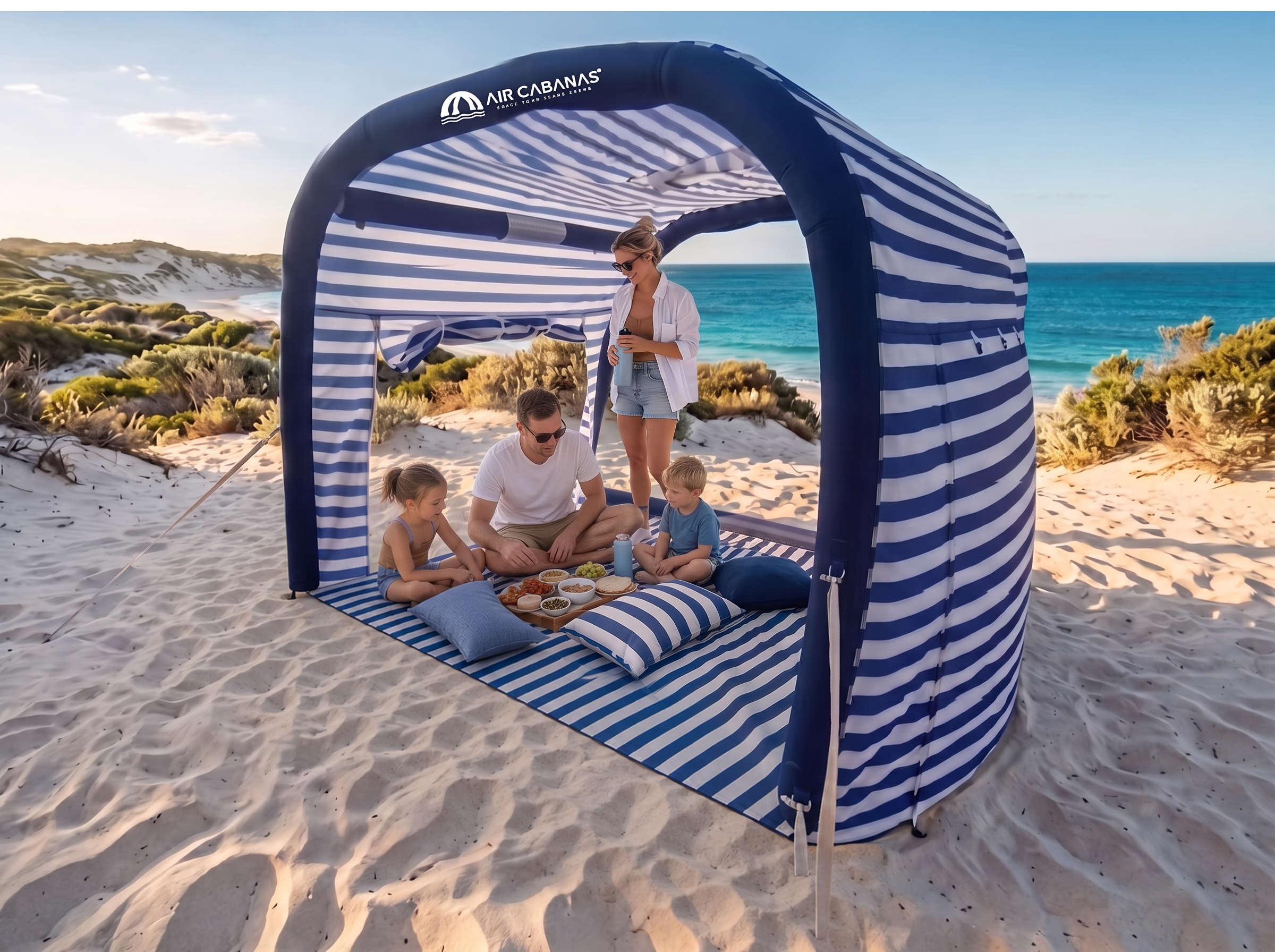
Heading down to the coastline on a brilliant Saturday morning is an Australian ritual, but battling fragile shade gear in a blustery coastal breeze is a quick way to sour your day. For decades, standard beach setups have relied on rigid steel or aluminium framing to hoist fabric above the sand. However, the rise of the air tube beach shelter is transforming coastal setups from Byron Bay to Margaret River. By replacing unforgiving metal struts with high-pressure, flexible pneumatic beams, beachgoers are discovering that structural resilience does not require rigid steel. Here is how modern air-beam engineering compares with traditional metal pole frames under genuine coastal conditions.
The coastal forces testing your beach shelter setup
A sunny morning on an Australian beach can change in an instant when a blustery southerly buster rolls through or an afternoon sea breeze kicks up along the coast. Whether you are setting up camp at Noosa, Cottesloe, or Torquay, your shade structure is subjected to relentless dynamic loads that push materials to their absolute limits. Wind on an open shoreline does not blow in a smooth, predictable laminar flow. Instead, it hits in erratic micro-bursts, swirling vortexes, and sudden directional shifts that lift, twist, and pummel anything anchored in the sand.
When evaluating an air tube beach shelter against conventional setups, understanding these fluid dynamics is vital. Traditional setups rely on rigid geometry to hold their shape, working against the breeze rather than with it. In contrast, inflatable structures are designed around fluid dynamics, absorbing kinetic energy and dissipating load across a pressurised bladder rather than concentrating stress into a single, unyielding structural joint. This fundamental mechanical difference defines how each canopy behaves when a sudden gust catches the fabric unawares.
Australian coastal conditions also introduce abrasive sand particles and corrosive salt spray into the equation, attacking the structural integrity of your beach gear from day one. Over several seasons, grit works its way into mechanical hinges, telescoping joints, and locking pins, causing friction and micro-fissures that weaken rigid systems. An air-beam architecture sidesteps mechanical junctions entirely, using internal air pressure to maintain form while eliminating the friction points that inevitably plague conventional beach canopies over repeated summer holidays.
Structural mechanics: How an air tube beach shelter handles wind
The defining structural battle between shelter types comes down to flex vs snap. When a high-velocity gust strikes an air tube beach shelter, the pressurised polyurethane or composite thermoplastic bladders respond through elastic deflection. The tubes naturally compress and bend, absorbing the impact energy and allowing the canopy to spill wind aerodynamically before instantly rebounding into their original shape once the pressure drops. Because the structure has high elasticity and no brittle points, it cannot snap under sudden overload.
Rigid shelters operate under a completely opposing mechanical philosophy. Steel or aluminium arms are engineered to resist deflection up to a predetermined yield point. When dynamic wind forces exceed that yield threshold, the metal suffers catastrophic structural failure—bending irreversibly or snapping at connection hinges, rivets, and telescopic sleeves. Once a metal spar is kinked, its structural integrity is permanently compromised, rendering the shelter unsafe and practically impossible to balance or erect properly again.
At AirCabana, the inflatable framework is engineered specifically around this principle of controlled deflection and immediate recovery. By balancing internal air pressure with reinforced textile outer sleeves, an AirCabana yields gracefully under sudden beach gusts without collapsing on occupants. The continuous, joint-free arches distribute wind energy down into corner sandbags and ground anchors, transforming what would be destructive shearing forces into manageable, dispersed tension across the entire footprint of the shade.
Metal pole vulnerabilities and mechanical failure points
To understand why traditional beach canopies fail, one must examine the engineering weak spots inherent in articulated metal frames. A standard pole-frame canopy depends on dozens of individual components: central hubs, spring-loaded detent pins, scissor struts, and hollow aluminium or thin-walled steel tubes. Every single rivet hole drilled into a metal arm creates a stress concentration zone where microscopic fractures propagate under repeated wind oscillation.
Furthermore, sand is the sworn enemy of moving mechanical parts. On any breezy afternoon, airborne quartz grains penetrate the sliding sleeves and folding knuckles of pole-frame cabanas. Once inside, these granules act as an abrasive paste, jamming locking mechanisms and forcing users to apply excessive force during pack-down. It is during these moments of frustration that thin-walled metal uprights are inadvertently bent, leading to misalignment that worsens with every subsequent beach trip.
Corrosion accelerates this mechanical degradation. Salt air rapidly oxidises exposed metals, seizing hinges and weakening joints from the inside out. Even anodised or coated poles eventually suffer from galvanic corrosion around stainless steel screws and brass pins. When a strong coastal gust hits an aged, slightly corroded metal frame, the metal lacks the ductility required to flex, leading directly to snapped corner arms, ripped fabric seams, and hazardous sharp edges protruding across a crowded family beach.
Repairability and packed size: Everyday ownership compared
Beyond how they behave in the wind, your overall experience with a shade canopy comes down to daily logistics: boot space, carrying weight, and maintenance. When considering repairability and packed size, the structural divergence between air beams and metal frameworks becomes stark. Pole-frame setups are notorious for their awkward, elongated transport bags that struggle to fit horizontally across standard car boots, often requiring back seats to be folded down or forcing families to angle them precariously over luggage and boogie boards.
In contrast, an inflatable shade packs down into a tight, rectangular duffle bag because there are no rigid internal bones dictating the minimum packed length. Once deflated, the fabric and flexible bladders fold compactly, leaving ample room in your vehicle for eskies, towels, and beach trolleys. For coastal families managing children and armfuls of beach paraphernalia, reducing bulk without sacrificing shaded coverage transforms the entire journey from the car park down across the burning dunes.
Maintenance and long-term upkeep also look very different between the two categories. With metal poles, a single bent arm often spells the end of the canopy, as sourcing brand-specific replacement struts and re-riveting joints is either prohibitively expensive or mechanically impractical for the average beachgoer. In an air-supported system, repairability is straightforward and user-friendly. Just like fixing a bicycle inner tube or a stand-up paddleboard, a small puncture can be permanently patched on the spot with standard adhesive patches, restoring complete structural integrity in minutes.
Setup rituals: Pumping air versus wrestling metal frames
The experience of pitching shade on a crowded beach sets the tone for your entire day. Anyone who has wrestled with a pole-frame canopy in twenty knots of wind knows the anxiety of trying to hold four moving metal legs steady while frantically shovelling sand into corner pockets before the structure flips inside out. Scissor-style metal linkages can catch fingers, and uneven ground tension can cause frames to bind during extension, turning what should be a relaxing morning into a stressful construction project.
Erecting an air tube beach shelter transforms this dynamic into a controlled, single-person routine. You simply roll the canopy flat across the sand, secure your initial anchor points or fill the integrated corner sandbags, connect the high-capacity hand pump, and introduce air. Within sixty to ninety seconds of light pumping, the structure lifts itself into shape smoothly and predictably, without flapping violently or threatening to spear neighbouring beachgoers.
This self-supporting erection method is particularly valuable for solo parents handling toddlers by the water. Because the frame remains soft and forgiving throughout the inflation process, there is zero risk of pinch injuries or heavy metal uprights toppling over while you secure the perimeter. Deflation is even faster: opening the wide-mouth release valve drops the structure flat instantly, allowing you to roll, pack, and head home before the afternoon storm breaks overhead.
Longevity, fabric tension, and Australian sun protection
A high-performance beach cabana must do far more than merely stand upright; it must maintain taut, uniform shade that shields delicate skin from harsh Australian ultraviolet radiation. Fabric tension is where an air tube beach shelter truly excels. Rigid metal frames inevitably develop slack over time as hinges wear and metal arms loosen in their housings, causing the overhead canvas to sag, flap noisily in the wind, and form pockets that trap heat underneath.
Continuous pneumatic pressure in an air-beam structure exerts steady outward force across the entire canopy, keeping the fabric drum-tight throughout the day. This tension minimizes annoying wind flap, reduces drag, and ensures that the protective UPF50+ fabric remains properly positioned to block scorching overhead sun. High-tension canopies also shed passing coastal drizzles effectively, preventing water from pooling on top and compromising structural balance.
Over multi-year usage, the absence of rigid abrasive points substantially extends the lifespan of the canopy material itself. In traditional pole shelters, high-friction contact points—such as the corners where metal caps grind against fabric seams under wind vibration—are the most common source of wear, tears, and pinholes. An inflatable beam presents a broad, cushioned surface that distributes fabric friction evenly, eliminating wear spots and ensuring your investment delivers reliable shade across countless coastal summers.
Frequently asked questions
Can an air tube beach shelter handle strong coastal winds?
Yes, an air tube beach shelter handles coastal breezes exceptionally well by flexing with gusts rather than snapping under stress. However, no beach shade is wind-proof. Always dig deep anchor holes, fill all sand pockets completely, monitor local weather conditions, and immediately pack down your shelter if conditions become hazardous.
What happens if an air cabana gets a puncture?
Punctures in quality air tubes are rare due to heavy-duty protective outer sleeves, but they are simple to fix if they occur. Much like repairing a bike tyre or inflatable SUP, you can apply a quick-seal adhesive patch directly to the inner bladder, restoring full pressure and structural rigidity in minutes.
How long does it take to pump up an air-tube shelter?
Inflating an air-beam shelter typically takes between sixty and ninety seconds using a standard double-action hand pump. Because the air chambers are optimised for quick inflation rather than extreme high pressure, the pumping process requires minimal physical effort and can easily be completed by one person on the sand.
Is an inflatable cabana lighter than a metal pole cabana?
While the total carry weight is broadly comparable due to the durable UPF fabrics and heavy-duty sand pockets, an inflatable model offers a significantly smaller packed size. Eliminating rigid, metre-long metal poles makes the shelter far easier to store horizontally in car boots and carry comfortably across dunes.
Are pole-frame cabanas more durable over multiple years?
Pole-frame cabanas frequently suffer from seized joints, sand abrasion, rust, and bent arms after repeated coastal use. Inflatable air-beam shelters eliminate moving mechanical parts, metal hinges, and rust risks, generally offering superior multi-season durability when properly rinsed and dried before long-term storage.